 |
 |
|
 |
||
|
"Whistleblower" in SCPNET reconstituted
ABUSE OF POWER and PUNISHMENTS WITHOUT CRIMES
Sometimes, you have to lose a job to find a voice INTRODUCTION This paper, published in the Society of Clinical Psychiatrists' website, had several interlinked purposes, its driving force a belief that in an advanced democratic society injustice ought to be capable of easy resolution. It was embarked upon during enforced inactivity with a broken leg, and as an experiment in writing an in-depth study which, by its nature, could be published only on the internet, drawing on the WWW's unique resource of hyperlinks for context and as per the above invitation for comments and corrections). It has grown over several years into a substantial piece of investigative journalism, on an esoteric topic of little public interest, revealing unexpected anomalies in the workings of one major government department (the Lord Chancellor's) which responded punitively to a complaint. It explores the realities of exaggerated claims that Britain has moved towards a climate of "openness" in public life. The paper is based upon persistent probing over a decade into the writer's own experience of seeking information from interlinked government organisations, and some concern has been expressed about its legitimacy in a professional website. It covers a period before and since the coming into operation of the Freedom of Information Act, and demonstrates by example that the Act's promise is tending to prove something of a chimera. COMPLAINING ABOUT A JUDGE Nobody complains lightly about a Judge, nor to one of Her Majesty's senior Ministers. During the 1990s "whistleblowing" purportedly became respectable, so that school and workplace bullying has now become anathema, whilst not eliminated. The outcome was dismissal of the complaint and of the complainer (long delayed and arguably perfunctory in its reasoning). That fostered an enduring sense of grievance and injustice. [Only very belatedly have I learned unequivocally the reality of the futility of complaining about a Judge to his superior, the Lord Chancellor; " The lord chancellor has a statutory obligation to defend the judiciary written into his job description - -" The Guardian 2006 ] My daring to complain rebounded. My suspensions and eventual dismissal from medical membership of the Mental Health Review Tribunal had consequent profound effects upon a professional career, income and personal life. Ministerial decisions, inevitably including occasional perverse ones, are unappealable except through complex judicial review, not lightly to be embarked upon and frequently unaffordable by an individual. Received wisdom is that whistleblowing is risky and necessarily to be forgone by those still on the career ladder, whose individual stories remain private and unshared except in confidential secrecy, such as the SCP provides in its support group for suspended doctors. The majority of its suspendee members are eventually fully exonerated. It is therefore only possible to share this experience of testing so-called “open government” because the writer is long retired and no more dependent for career progress upon approval and patronage. Advice received in my case has ranged from " forget it, and get on with your life " to " it is inconceivable that the Lord Chancellor would not support one of his judges " and, in respect of the (fifth) review (recommended ten years after the first of two suspensions and complaint about it), a warning that it was " vanishingly improbable " that yet another review recommended to the present Lord Chancellor by an official in his Department would make any difference... Only after a decade-long saga of correspondence, with shorter paper publications intervening on some aspects of the problems, was a face-to-face meeting finally convened with someone in the long chains of power holders and their representatives,, after years of trying. But frustratingly this proved to be ring-fenced and not the anticipated opportunity for mutual exchanges towards concensus and righting wrongs. HISTORY During the 1990s "whistleblowing" became respectable, and school and workplace bullying has now become anathema, though far from eliminated. Two commonplace and unremarkable incidents at Mental Health Review Tribunal hearings in 1994 and 1997, which have been written up elsewhere, and would more usually have passed without special notice, led to a complaint by a senior consultant psychiatrist (the writer) about how a Regional Chairman of the MHRT had over-responded to two matters brought to his attention, distorting and blowing them up out of all proportion. Complaining rebounded, unexpectedly and long afterwards, resulting with his dismissal by the
This paper illustrates by graphic example how some aspects of British "open government" are still paralysed by its reliance upon the enshrined doctrine that ministerial decisions, however flawed, are unappealable once they have been taken [Google lists 222 English pages for "ministerial decisions unappealable"] and that without, it seems, any relaxation with the Freedom of Information Act coming into force of the at the beginning of 2005. This tradition engenders a world of unreality in which admission of human error and apology becomes impossible. A procession of loyal officials, with their hands tied behind their backs, has tried to bolster up a patently flawed Decision (drafted apparently by a civil servant, NRO, and signed by the then Lord Chancellor, Lord Irvine) by evading persistent questioning from the consultant psychiatrist victim, his MP and the Society of Clinical Psychiatrists, year after year. Admitted illegality in the original actions was brushed aside loftily as irrelevant, and the last of 13 representatives of the two Lords Chancellor's departments has justified the refusal of meetings throughout by characterising the persistent representations as 'a crusade'. He vented his irritation that his hands are tied by threatening to dub the writer a 'vexatious correspondent'. Daring to complain about a retired Judge had rebounded after a long wait. Suspension and eventual dismissal from medical membership of the Mental Health Review Tribunal had consequent profound adverse effects upon a professional career and personal life. This paper, too lengthy for paper publication, seeks to comprehend an unusual sequence of events, and to document in depth processes of governmental decision making, notably high levels of secrecy and protective defensiveness which ought to have become unthinkable in an open democracy around the turn of the century. “ - - the power to withhold the documents from you is discretionary " - - If ever you want to hold power accountable, you need access to the documents - - " In particular, it challenges the basis of the Government's refusal to disclose crucial documentation, “evidence” which, had it been accepted unquestioningly at face value, might have caused, and conceivably could even have justified, unique and disproportionate punishments for what could only be properly characterized as questionable or (at the highest) very minor misdemeanours. It is only possible to share this experience of testing so-called “open government” because the writer is virtually retired and so no longer dependent for career progress upon approval and patronage. Necessary circumspection has ensured that the full stories of the far more numerous and news-worthy suspensions of NHS consultants in mid-career remain hidden. The majority of them are eventually fully exonerated. - - - - - - - - - - - - - - - - To leaven a heavy read, and hoping to help excuse its length * , the narrative is punctuated with newspaper quotes which may broaden the context and help to hold readers' attention? * Unique perhaps in medical journalism, political theatre has successfully adopted a like method to get unsavoury realities across to a wider public. E.g. What I Heard About Iraq at Edinburgh Festival 2006, using only fully verifiable facts and quotes, demonstrates the secrets behind the lies about Iraq as a theatrical collage. It " makes you question just about everything you've heard and read. - - It's like watching someone trying to dig themselves out of a deep hole and only succeeding in covering themselves with sand - - in a world where it's increasingly difficult to know what to believe, you can't just take words at face value but must learn to read between the lines ". ( Guardian August 2006 ) “I felt isolated and bereft - - as though all the years I have put into my job were for nothing"
Abuse of power in large institutions and excessive government secrecy are underlying themes of the paper. For background orientation towards my argument, I turn usual practice on its head by listing first a few important references - their full texts are available on request: Greenblatt, M. (1986) The use and abuse of power in the administration of systems House, Robert J. (1991) The Distribution and Exercise of Power in Complex Organisations Woolf, P.G. (2003) Openness Denied – Excessive Government Secrecy? (Full reading list at end of this paper; several of my own publications about the MHRT can be read on the SCP website - (Points of View: Tribunals ) - - - - - - - - - - - - - - - - - - This exploration has been long in gestation and revision, its development prompted by thinking about a number of long delayed eventual reversals of injustices and of criminal convictions (some of them achieved posthumously, and only after years of persistent campaigning). During a period of enforced confinement with a broken leg, during which the bulk of this paper was compiled, I reviewed my own experience in the dramatic context of the ongoing Hutton Inquiry , during which “ - - the inner workings of the British government were laid bare as seldom before ”
" Lord Hutton wanted every document entered as evidence and every word put on the website, which, after six years dealing with freedom of information [at the Home Office], I thoroughly approve of. We wanted to be as open as possible "
Duplicity, evasions - but no answers - - When the powerful feel threatened, I shall provide extensive extracts from correspondence with the former Lord Chancellor's Department (LCD) - now the Department of Constitutional Affairs (DCA) - some of it latterly by email. The ‘caretaker' Lord Chancellor (who had a lot placed on his plate for a likely brief tenure) disappointingly ignored pleas by the writer's MP (a fellow government minister!) to make Dr Woolf ' privy to any complaints about him ' and to review the case in its entirety; instead in January 2004 he merely endorsed the decision taken by his predecessor six years before, apparently without having been given by the civil servants an opportunity to genuinely review a dubious initial decision, and did so again in 2005 following re-referral by one of his own civil servants. Internal evidence indicates strongly that neither of the two Lord Chancellors was in a position to exercise his trained senior QC mind upon the actual submissions, and the background to them, before penning his signature to responses drafted by civil servants unfamiliar with the practicalities of psychiatric work. Nor in the voluminous correspondence is there any indication that any of the three Departments involved (Department of Health, Lord Chancellor's Department and Department of Constitutional Affairs) had sought advice from an independent consultant psychiatrist, ideally one with experience in urban city centres who could have provided perspective on the difficult realities of the onerous task of making preliminary, community based, examinations of prospective patients, to help decide whether they should be admitted under Section 2 of the Mental Health Act for fuller assessment in hospital. These extracts from the voluminous correspondence which are appended after the body of this paper are but the tip of an iceberg, held in three thick lever-arch files and on computer. They are necessarily shortened, hopefully without distorting their essence – complete copies are available. - - - - - - - - - - - There is extensive documented corroboration and support for the position taken by the writer, with powerful specialist legal input, although many relevant organisations have preferred to distance themselves from active involvement - the Society of Clinical Psychiatrists the most notable exception. Little by little it was learned that the GMC has no jurisdiction, nor likely influence, over the administration of the MHRT (its President declined to intervene); the Council on Tribunals astonishingly deemed the plight of tribunal members to be none of their concern. The Royal College of Psychiatrists decided that a support system for doctors providing services related to mental health law was desirable, but outside their remit. Public Concern at Work - the whistleblowing charity - explained that the issues do not fall within their area of expertise, and drew my attention to The Campaign for Freedom of Information which campaigns against unnecessary official secrecy.... Representatives of both the Department of Health and of the Lord Chancellor's Department had over many years invoked the Data Protection Act to justify their stance, the LCD going to the length of buttressing non-disclosure by obtaining fresh legal opinion which, in turn, they refused to disclose, and which subsequently was established as flawed; the LCD was eventually forced to concede that that Act had never applied in my case! Most victims of this inequity between government and the governed would have wilted under this heavy weight of assumed and presumed authority. Only persistent challenge established that it was ill-founded, and recent scandals have prompted a review of the Data Protection Act. After nearly a decade of strong representations and persistent enquiries, the LCD & DCA, to their credit, finally confirmed that the correspondence with their Departments is “not privileged” from publication, which makes what follows perhaps unique? That admission finally obtained contrasts starkly with their zealous maintenance afterwards of their own discretionary right not to disclose essential documents and information, held onto with a pertinacity which may surprise some readers. “The Data Protection Act 1998 is truly a rogues' charter. Byzantine and incomprehensible, even to judges and specialist lawyers, it can consequently be prayed in aid, however preposterously, "A law intended to protect privacy is to be reviewed - - John Reid, the Health Secretary, said a fresh look at the Data Protection Act was needed - - the Act should not be used to excuse failures on the part of - - public agencies. Lord Filkin, minister at the Department of Constitutional Affairs, said that he would consult the Information Commissioner on whether "more guidance" should be given about the law's implementation." The Truth about Lying: Collins dictionary gives two definitions: 1) to speak untruthfully with the intent to mislead or deceive;
UNNECESSARY OFFICIAL SECRECY? Once it had been established that the essential information sought was not covered by any mandatory regulations, the new Department of Consitutional Affairs nonetheless saw fit to continue to invoke 'discretionary powers' to endorse and maintain their non-disclosure stance! Why the powerful government departments involved have felt the need to strenuously resist legitimate questioning and maintain a climate of secrecy remains a mystery? It undermines the climate of respectability supposedly achieved for ‘whistle-blower' victims of abuses of power. SETTING THE SCENE Having a wide experience in many relevant capacities, I was called upon to lecture on the roles of doctors who are variously required to produce tribunal reports on their patients, prepare independent reports for patients' legal representatives, and to sit on the panels as medical members of the MHRT. I also published on that theme for the Royal College of Psychiatrists. Prior to his untimely death I had enjoyed the confidence of the universally respected solicitor Regional Chairman, the late Mr James Cooke. I accompanied him to the House of Lords when changes to the Mental Health Act 1983 were being debated. The co-founder of the MHRT Members' Newsletter and myself sat on the tribunal panel with Mr Cooke at his last appearance as President, during which his terminal illness sadly became manifest. He had been a friend to his legal, medical and lay Members and, with best endeavour, represented their interests to those in high places. Things changed dramatically in 1994 under the next Regional Chairman, a retired Crown Court Judge [HP] whose relevant prior experience had been mainly (perhaps exclusively) presiding over special “strengthened” tribunals for “restricted” psychiatric patients, those who had been detained in hospital for treatment, generally without limit of time, and subject to Home Office control, because of the seriousness of their offences. Their tribunal applications were invariably prepared thoroughly, with comprehensive paper work as for a Court, and were heard before panels presided over by Judges and QCs. The hearings for “S 2” assessment cases were, necessarily, often very different from those for the restricted “S 41” patients with which he was familiar. That new Regional Chairman [HP] was a “new broom”, who advised prospective legal presidents not to be over-influenced by their medical colleagues, the psychiatrists. His own practice at those hearings he chaired was, unusually, to take most of the questioning himself. He actively ‘monitored' tribunal hearings in the Region to an unprecedented extent, seemingly unaware of the effect of his frequent appearances, which were frankly oppressive. Acting as the President of hurriedly convened Section 2 reviews of patients detained for assessment for up to 28 days, the new Chairman confessed himself out of his depth in this unfamiliar arena at first, confronted with often incomplete preparation for those hearings, reports frequently scanty (sometimes none) and doctors and social workers appearing before him who might not know the applicants. He was accordingly ill-equipped to evaluate complaints arising after such hearings. Two of those complaints, neither made overt during the hearings, and the second never attributed openly to its source, led to his suspending me twice, a probably unique occurrence. He did not seem to embrace a 'duty of care' towards his members as their representative to officialdom, to balance the disciplinary role in which he saw himself placed. Previously, earlier in 1994, I had urged the need for a proper Complaints Procedure, as was common elsewhere. The Members Newsletter Board deemed it prudent to explore this obvious need behind the scenes, rather than by publishing my proposal. Long after the 1997 suspension, about which I lodged a detailed 40 paragraph formal complaint (assisted by a specialist barrister who is now an MHRT legal president), and not until after that Regional Chairman's appointment had come to an end was I unexpectedly dismissed by the Lord Chancellor, as a person “unsuitable to continue to act as a medical member in any Region of the MHRT” , that stemming from his much earlier recommendation (I having declined to resign) . Chris Jackson, 56 - - a magistrate from Rugeley, Staffordshire - - said: Dr Dizaei, PhD in race relations, said after the collapse of his trial: “No one should be bullied out of a job” None of the three disciplinary actions, two suspensions and the ultimate dismissal, made sense to medical and other colleagues who learned about them, as is very fully documented elsewhere and was made known to all concerned. This paper is an attempt to throw light upon how those suspensions could have come about and how the totally unexpected dismissal, long afterwards, was maintained against all the evidence. Eventually, at my instigation, but too late to help me, my efforts to right the wrongs bore fruit in a new, and first, MHRT Complaints Procedure (May 2000) whose unexceptionable aims were summarised in its preamble: The Mental Health Review Tribunal wishes to encourage The full text of the Complaints Procedures can be accessed on the very new MHRT website (October 2004). None of its obviously worthy aims has pertained in my own correspondence with officials in the Tribunal, the Department of Health, and some other organizations approached. RETROSPECTIVE AND NON-RETROSPECTIVE The new arrangements were introduced with a “non-retrospective” caveat, which the LCD has never explained and indeed has cited in support of their refusal to re-examine my case? That has a piquant obverse, turning my penny on its head; the proposal to ban Peers convicted of serious crime from the House of Lords, announced on the very day of Lord Geoffrey Archer's return to public life, is drafted to be retrospective in effect - a provision which has been widely attacked as possibly in breach of Human Rights. Lord Strathclyde: “Of course it's vindictive - - What worries me very much is its retrospective nature, and legal experts are already saying it offends against the Human Rights Act.” Letters to the Editor: - - to propose retrospective legislation - - to punish a man for his past crimes is a disgraceful abuse of executive power. - - - Article 7 of the European Convention on Human Rights - - prohibits convictions for “any act or omission, which did not constitute a criminal offence . . when it was committed” and continues: “Nor shall a heavier penalty be imposed than the one that was applicable at the time the criminal offence was committed.” It follows that the Government cannot strip Jeffrey Archer of his life peerage, or ban him from the House of Lords. At least, that proposal before the Lords will be subjected to debate! Without any comparable opportunity to challenge any of the four successive ‘executive decisions' - I was suspended (twice), excluded from the Members' Annual Meeting whilst still a medical member of the MHRT, and later punished and disgraced by dismissal from the MHRT (though not imprisoned for my alleged peccadilloes) - and imperfect though any analogy be, I find myself a sympathetic if strange bedfellow of the disgraced peer. [ Addendum 1 12 2004 ]: The origin of the crucial "non-retrospective" caveat has been very belatedly disclosed by MK, the Regional Chairman who succeded "HP" and fronted the drafting of the Complaints Procedure:
The Mental Health Review Tribunal is a specialised, esoteric medico-legal backwater which operates on the periphery of public awareness, albeit a bastion for civil liberties of some of the most vulnerable members of our society; its workings have never attracted media interest. The numerous individual civil servants through whose hands my MHRT papers passed succeeded each other in rapid and bewildering succession - the LCD was latterly re-constituted in 2003 as the Department of Constitutional Affairs (DCA) headed by a new, transitional Lord Chancellor. None of those officers, who wield such power behind the scene, has agreed to meet me, nor to welcome me for discussion with a representative of the Society of Clinical Psychiatrists. The 'economical', formulaic responses signed by the former Lord Chancellor and his successsor displayed a paucity of critical acumen. They compound a relentless, rigid unwillingness to review patent injustice and abuse of power, which had been the subject of carefully considered, formal complaint. To avoid this paper becoming excessively long, I shall illustrate my own experience chiefly from correspondence with the Lord Chancellor's Department (LCD). That correspondence, which has been confirmed by them to be ‘non-privileged', illustrates graphically the workings of Government around the turn of the Century. There has been similar evasion and defensiveness in resisting legitimate enquiries to the MHRT administration and its personell, and to the Department of Health which oversees its activities. It has been a frustrating saga of attempts to make personal contact with people and organizations that might have been expected to provide necessary information in a spirit of openness and helpfulness, conspicuous throughout by its absence. CONFLICTS OF INTEREST This complex area has been cited as a chief ‘reason' for my punishments. It merits closer examination, especially in view of the attitudes and untrammeled practice of the Chairman concerned. Prior to his appointment, all members were aware of conflict of interest possibilities, and occasionally acted to disqualify themselves from a panel, e.g. doctors who had treated the applicant recently, as specified in the Tribunal Rules. Consultant psychiatrist experts in forensic practice are well accustomed (as are barristers) to accepting instructions variously from solicitors acting for plaintiffs and at other times from those acting for defendants and the prosecution; the importance of retaining independence, and reporting to the Court, is well understood (latterly, joint instructions of a single expert have become common) The Regional Chairman took that consideration to an extreme in my case, and his doing so was the subject of vigorous correspondence in private and in public. It had become accepted practice that lawyers who regularly represented MHRT applicants for tribunal hearings should, when appointed as Legal Members of the MHRT, sit in other Regions, for the consideration of possible conflicts of interest. That Chairman had taken upon himself, it emerged, to dictate to the regular legal representatives of patient applicants in his Region that they were not to instruct ‘his' members to prepare independent reports for tribunals. (That was not discussed openly, and only came to light after referrals for tribunal reports had mysteriously ‘dried up'.) REGIONAL CHAIRMEN'S ROLES AND RESPONSIBILITIES Meriting deeper consideration are the inbuilt conflicts of interest appertaining to the Regional Chairmen themselves. These had, so I understand, not come to the fore elsewhere or previously; commonsense used to prevail. Regional Chair appointments carried multiple roles and responsibilities. The chairmen were responsible for appointing for each hearing a panel of three members, a legal president, a medical member and a lay member. That task is normally delegated to office staff (there were rumblings sometimes about inequable allocation of bookings). The Chairman would, from time to time, appoint himself as President of a tribunal, in that role becoming one of three equal decision makers. Lastly, the Chairman's role was crucial in recommending, or not, reappointment of tribunal members after a specified term of office. Suffice it to say that such a rich brew of potential conflicts of interests carries a particular hazard in situations of personality clash, which are inescapable in complex organizations. The niceties of preliminary examinations by medical members, and the issue of a member's possible previous contact with an applicant (of which it was alleged I had fallen foul) pales by comparison with the risks of conflicts of interest that confront regional chairmen themselves! Maybe a Chairman with such strong and rigid views as [HP] ought to disqualify himself from presiding at hearings in his own Region? In reflecting upon the thorny topic of conflicts of interests in the MHRT, a noteworthy legal opinion has been received from Anthony Bingham, a barrister active in the field. "TOO PERSONAL" Before quoting the correspondence in detail I must indicate another reason why, for the record, this paper on the WWW is necessary. A number of previous submissions for publication, some of them invited after an initial show of interest, failed to reach the press, or did so in an emasculated form, personal aspects of the problems having been editorially diluted or deleted. Some “scientific” journals demanded wider surveys with statistics, which were not readily available. I had noted a change over several decades past in that single case studies – here, my own case - had become suspect, and were rejected under the more rigorous requirements of scientific validity. Three of my single case studies were eventually published by the Society of Clinical Psychiatrists, which takes an independent stance, and is renowned for its unswerving support of wrongly suspended doctors, individually, and through persistent media exposure of the problem. More than once has rejection of texts been explained as because the material was “too personal”. Legal sections of the broadsheet press expressed interest, but this lapsed, doubtless because the topic was considered too marginal for their readerships. Only the internet offered scope for a full examination of the issues. DEFENDING THE INDEFENSIBLE - AN IRREVERSIBLE MACHINE Study of the correspondence appended to my discussion of the background may lead readers to wonder why the draconian punishments of suspension (effectively dismissal in the particular circumstances) were applied, endorsed by the LCD and relentlessly maintained against all reason? [Mr Bush] should also drop the administration's " never apologise, never explain " approach to policy. I was already over 70 when dismissed ignominiously, serving in discretionary ‘overtime' (because of the shortage of experienced medical members, extensions of appointment beyond the retiring age of 70 had become necessary to keep the system going). ‘Non-renewal', with the customary letter of thanks for long service, might have been more appropriate than dismissal, and would have saved the LCD the hassle of trying to defend the indefensible during the subsequent years, not to speak of a large expenditure of public money. - - A health minister blames a suspended doctor's personal media campaign for the two-and-a-half-year delay - his supporters maintain he was targeted because he blew the whistle - the cost of the suspension One can hypothesise that experienced civil servants in the government departments (one rarely knows their level of seniority and relevant experience, if any) are blinkered and trapped by working in an institutionally rigid and inflexible environment, without easy access to relevant advice, in this instance from fellow consultant psychiatrists familiar with the actualities of domiciliary assessments and S2 tribunal hearings in city centres. It may also be fairly said that the wordings of the Lord Chancellor's crucial endorsement of the ‘incorrect' de-facto dismissal by [HP], one of his Judges, and of his repeated reiterations that he stood by it, do not carry conviction that the drafts had been thought through thoroughly before being signed by an eminent QC elevated to one of the highest offices in the realm.
CONFLICTS OF INTEREST This complex area has been cited as a chief ‘reason' for my punishments. It merits closer examination, especially in view of the attitudes and untrammeled practice of the Chairman concerned. Prior to his appointment, all members were aware of conflict of interest possibilities, and occasionally acted to disqualify themselves from a panel, e.g. doctors who had treated the applicant recently, as specified in the Tribunal Rules. Consultant psychiatrist experts in forensic practice are well accustomed (as are barristers) to accepting instructions variously from solicitors acting for plaintiffs and at other times from those acting for defendants and the prosecution; the importance of retaining independence, and reporting to the Court, is well understood (latterly, joint instructions of a single expert have become common) The Regional Chairman took that consideration to an extreme in my case, and his doing so was the subject of vigorous correspondence in private and in public. It had become accepted practice that lawyers who regularly represented MHRT applicants for tribunal hearings should, when appointed as Legal Members of the MHRT, sit in other Regions, for the consideration of possible conflicts of interest. That Chairman had taken upon himself, it emerged, to dictate to the regular legal representatives of patient applicants in his Region that they were not to instruct ‘his' members to prepare independent reports for tribunals. (That was not discussed openly, and only came to light after referrals for tribunal reports had mysteriously ‘dried up'.) REGIONAL CHAIRMEN'S ROLES AND RESPONSIBILITIES Meriting deeper consideration are the inbuilt conflicts of interest appertaining to the Regional Chairmen themselves. These had, so I understand, not come to the fore elsewhere or previously; commonsense used to prevail. Regional Chair appointments carried multiple roles and responsibilities. The chairmen were responsible for appointing for each hearing a panel of three members, a legal president, a medical member and a lay member. That task is normally delegated to office staff (there were rumblings sometimes about inequable allocation of bookings). The Chairman would, from time to time, appoint himself as President of a tribunal, in that role becoming one of three equal decision makers. Lastly, the Chairman's role was crucial in recommending, or not, reappointment of tribunal members after a specified term of office. Suffice it to say that such a rich brew of potential conflicts of interests carries a particular hazard in situations of personality clash, which are inescapable in complex organizations. The niceties of preliminary examinations by medical members, and the issue of a member's possible previous contact with an applicant (of which it was alleged I had fallen foul) pales by comparison with the risks of conflicts of interest that confront regional chairmen themselves! Maybe a Chairman with such strong and rigid views as [HP] ought to disqualify himself from presiding at hearings in his own Region? In reflecting upon the thorny topic of conflicts of interests in the MHRT, a noteworthy legal opinion has been received from Anthony Bingham, a barrister active in the field. "TOO PERSONAL" Before quoting the correspondence in detail I must indicate another reason why, for the record, this paper on the WWW is necessary. A number of previous submissions for publication, some of them invited after an initial show of interest, failed to reach the press, or did so in an emasculated form, personal aspects of the problems having been editorially diluted or deleted. Some “scientific” journals demanded wider surveys with statistics, which were not readily available. I had noted a change over several decades past in that single case studies – here, my own case - had become suspect, and were rejected under the more rigorous requirements of scientific validity. Three of my single case studies were eventually published by the Society of Clinical Psychiatrists, which takes an independent stance, and is renowned for its unswerving support of wrongly suspended doctors, individually, and through persistent media exposure of the problem. More than once has rejection of texts been explained as because the material was “too personal”. Legal sections of the broadsheet press expressed interest, but this lapsed, doubtless because the topic was considered too marginal for their readerships. Only the internet offered scope for a full examination of the issues. DEFENDING THE INDEFENSIBLE - AN IRREVERSIBLE MACHINE Study of the correspondence appended to my discussion of the background may lead readers to wonder why the draconian punishments of suspension (effectively dismissal in the particular circumstances) were applied, endorsed by the LCD and relentlessly maintained against all reason? [Mr Bush] should also drop the administration's " never apologise, never explain " approach to policy. I was already over 70 when dismissed ignominiously, serving in discretionary ‘overtime' (because of the shortage of experienced medical members, extensions of appointment beyond the retiring age of 70 had become necessary to keep the system going). ‘Non-renewal', with the customary letter of thanks for long service, might have been more appropriate than dismissal, and would have saved the LCD the hassle of trying to defend the indefensible during the subsequent years, not to speak of a large expenditure of public money. - - A health minister blames a suspended doctor's personal media campaign for the two-and-a-half-year delay - his supporters maintain he was targeted because he blew the whistle - the cost of the suspension One can hypothesise that experienced civil servants in the government departments (one rarely knows their level of seniority and relevant experience, if any) are blinkered and trapped by working in an institutionally rigid and inflexible environment, without easy access to relevant advice, in this instance from fellow consultant psychiatrists familiar with the actualities of domiciliary assessments and S2 tribunal hearings in city centres. It may also be fairly said that the wordings of the Lord Chancellor's crucial endorsement of the ‘incorrect' de-facto dismissal by [HP], one of his Judges, and of his repeated reiterations that he stood by it, do not carry conviction that the drafts had been thought through thoroughly before being signed by an eminent QC elevated to one of the highest offices in the realm.
EXTRACTS FROM CORRESPONDENCE Main personages: DH (Department of Health) LCD (LORD CHANCELLOR'S DEPARTMENT) Legal Advice Lucy Scott-Moncrieff (LS-M) 1 July 1997 HP to PGW 10 July 1997 PGW to HP 11 11 97 PGW to KG ( LORD CHANCELLOR'S DEPARTMENT Selbourne House) 16 3 98 HARB to PGW 26 3 98 PGW to CL, MHRT (c to HARB, LCD) 3 April 1998 HARB (Judicial Appointments Division 2) to PGW You have asked for a statement of 'allegations' against you. I do not have a document that might be described as a 'charge sheet' setting these out. - - I do have correspondence - - which indicate the reasons for his instruction that you should not sit as a member of the Mental Health Review Tribunals in the South Thames Region followed your failure to act upon an alleged conflict of interest at a tribunal hearing on 6 May 1997. - - Your reply of 25 May did not persuade him that you had either recognised or taken sufficient steps to avoid a potential conflict of interest. - - I have written to him to seek, on the Lord Chancellor's behalf, his reaction to your amended letter of 25 September, and to clarify his understanding of your position, and his powers as Regional Chairman. I will write to you again - - to let you know what the next steps will be. - - 6th April 1998 PGW to HARB I have today received from (HP) - - " there seems little point in your attending my members' meeting ", (this in response to my request to the MHRT for the Agenda and discussion papers for the forthcoming meeting on 20th Apri1). Thank you for confirming that there is no hidden " charge sheet " . I note also that your papers do not include statements from relevant individuals present at either of the contentious tribunal hearings. - - I look forward to having an opportunity to see and comment upon (HP's) reaction to my complaint in due course, and to study his clarification to you of his own understanding of my position and of his powers as Regional Chairman. - - 1 June 1998 PGW to ZM (Head of Mental Health Review Tribunal Secretariat, Dept of Health) 4 June 1998 ZM to PGW 12 June 1998 PGW to ZM 22 June ZM to PGW 16th July 1998 PGW to NRO (LCD) I acknowledge having now received on return from holiday the Lord Chancellor's Decision that I may not continue to sit in any Region. If that Decision is subject to Appeal, would you please let me know the correct procedure? 22 July 1998 NRO to PGW 1 October 1998 JS (LCD) to PGW 12 October 1998 PGW to JS Thank you for letting me know that you have my complaint and enquiries in hand for a substantive reply in due course, following my protracted and frustrating, mainly one-sided correspondence with a multitude of your colleagues - - . I did, of course, never receive any substantive reply to my complaints and proposals . Lord Irvine's letter eventually dealt with HP's letters of complaint about me (though not before the Judge himself had complained about the delay). I was never allowed to see the letters about myself, although I had warned repeatedly of possible inaccuracies and distortions in them. He endorsed (HP's) reasoning and actions retrospectively, and also refuted the legal basis of my submissions in a manner which has left me unconvinced. However, in my lengthy response of 27th July I pointed your department back towards my belief that many central concerns had not been addressed . (RNO) had nothing to add. I enclose now for easier reference a further copy of that response with outstanding, unaddressed key points highlighted - - I enclose also a discussion paper from 1994 with draft proposals for a more effective and safer way of organising communications and dealing with problems within the MHRT. - - the Newsletter board (which included (another) regional chairman - - took the view collectively that progress on those lines would better be pursued at that time by negotiation "behind the scenes", rather than through publication. With hindsight, that appears to have been a mistake! I hope you may find it of interest, and as supporting - - my serious concern for the well being of the MHRT and my "consistent and active contribution - - which had greatly enhanced Editorial Board discussions" (Howell, Members' News Sheet Editorial, Sept 1997). I believe that I was quite the wrong member to have been dismissed by the Lord Chancellor (the first probably to suffer in this way in the South England Regions in recent years ?) and this is an opinion widely shared amongst the membership. - - 14 October 1998 JS to PGW I can tell you that on occasions it is possible to judicially review the decisions of Ministers. - - no separate cumulative records have ever been kept of suspensions or dismissals in the Mental Health Review Tribunal. This applies equally to other Tribunals for which the Lord Chancellor is responsible. The relevant correspondence is of course retained on the file of the individual in question. - - The Lord Chancellor has recently created new posts of Regional Chairman to the Mental Health Review Tribunal. Consideration of any formal grievance procedure will lie with those who now fill those posts, in consultation with the Department of Health and this Department as appropriate. 1st November 1998 PGW to JS - - you will recall that [HP] ignored your Department's invitation to retum his comments upon my representations, prior to the Lord Chancellor's determination of the matter in dispute. I enclose for your interest a letter accepted by the Royal College of Psychiatrists, for publication - - . My own continued constructive interest in the MHRT is widely appreciated, despite my exclusion - - from active involvement - - and eventually by the Lord Chancellor for all Regions. I have been invited to (another) Region's annual members' party next month, and last week I was invited by one of London 's teaching hospitals to lecture about the MHRT! I would remind you that in my original complaint of 25 9 1997 (paragraphs 6 & 7) I had decided (contrary to advice) that I preferred to raise my concerns in a manner which would lead to constructive change, rather than in court where your Department might be tempted to go on the defensive ... I wonder whether the course which has in fact been taken in response to my complaint is not beginning to cause just a little regret, and maybe even some embarrassment, in Selbourne House? I have of course had no substantive reply, despite several promises . Nor have I had any intimation that it is intended to institute formal measures which would render an experience such as mine improbable in the future. Are you able, and willing, to confirm whether my proposals for a formal complaints procedure will be put forward now for consideration by the four newly appointed and reappointed Regional Chairmen at their first meeting. 19 November 1998 JS to PGW Your October communication included an annotated copy of your letter of the 25 September 1997 . I have shown this to [Mr NRO], who has nothing to add to his original correspondence. - - The contents of your November letter are noted, and that you prefer to raise your concerns in a manner which would lead to constructive change. - - the new Regional Chairmen are considering in conjunction with Department of Health and Lord Chancellor's officials whether some internal procedures relating to complaints by members need to be established - - I anticipate that views will have been taken and discussed by the Spring of next year. 2nd December 1998 PGW to JS The problem is that members are vulnerable to complaints and that there is no proper complaints procedure to deal with complaints about them. (There is the additional injustice that when the Lord Chancellor might, acting upon advice, get it dreadfully wrong, as in my case, there is no realistic, affordable remedy.) I am pleased to learn that I have got through to you, at least to the extent that some of the problems I have aired since 1994 will now get serious discussion in 1999, at very long last. I hope I may be told the eventual outcome? Perhaps then I might receive also the usual letter of thanks for long, loyal and diligent service, as enjoyed by retiring tribunal members in the past? January - July 1999 excerpts from correspondence between PGW & MK with a belated clarification in November 2004 [This last is one of several kindly recommendations received, urging that I would be best advised to 'put it behind' me and 'get on with a life'! That I have done so, whilst continuing to pursue this complaint also, will be apparent to observant readers who may have noticed that I have been maintaining a music journal , the second of two music websites which I founded since retirement from the NHS, maintained as a fulfilling hobby after losing my main medical employment associated with membership of the MHRT. 12th February 1999 PGW to JS Will I - - be given the details of any complaints procedure proposed and - - finally accepted, please? (There are others too, members present and past, who might welcome an opportunity to comment.) You have kindly confirmed the lack of statistics about suspensions and dismissals in your department. The DoH's position is similar - - because instances of suspension (and of the suspected practice of "not using" certain members) are not necessarily brought to central attention. - - can you confirm whether the present non-existence of any proper complaints procedures to protect MHRT members at either level, regionally or centrally, applies equally to the other tribunals, and also to "other judicial appointments" for which the Lord Chancellor is responsible? I would mention also that I have a letter about the MHRT in the January Bulletin of the Royal College of Psychiatrists, and a fuller article to be printed shortly. You may well find that these do not square well with a doctor deemed unfit to be a MHRT medical member, as I have been dubbed after so many years service, with such very damaging consequences? - - I have found myself fantasising recently an improbable scenario in which you were advising that I should be reinstated (you had done so inadvertently in July - - !) for a second time, to the new Region now under [new] regional chairmanship, until my natural retirement later this year. That was what [ZM] of the DoH and I had anticipated, until shortly before the quite unexpected letters from your department- - Were such reinstatement possible, it might demonstrate a human face in your bureaucracy, and restore some belief that our fragile democracy is still concerned with natural justice and due process, in the context of tribunals, which operate justice with transparency, with openly disclosed evidence and 'reasons for reasons' of all decisions. I have previously provided you with a copy of Dr DW's letter - - on those issues - - which accords with those of numerous medical colleagues and former MHT colleagues from whom I was so suddenly and unreasonably cut off. I wonder whether a sensible way forward now might be for you to consider offering a meeting with yourself and, say, NRO (the one who never has anything to add!), to include also MB of the DoH - - (In the past I have found, in respect of my hospital patients subject to Restriction Orders, that face to face discussion with Home Office officials has resolved difficulties quickly, after protracted correspondence at seeming cross purposes.) - - 2/3/1999 (PT SCP to The Lord Chancellor) We have in mind Dr. Peter Woolf who was suspended twice on the say so of the regional chairman, barred from taking part in tribunals (and thereby losing his public service income) and after protracted correspondence was finally dismissed following the judge/chairman's belief that the doctor has committed a serious misdemeanour - - this so called serious misdemeanour was that the doctor had failed to recognise an appellant before him at a tribunal as a person with whom he had once had professional contact in the past. This appears to have been brought to the attention of the judge/regional chairman and appears to have annoyed him and perhaps he allowed his own disturbed emotions to influence him. The doctor was suspended forthwith and eventually dismissed. Thus the doctor's professional reputation has been destroyed and his livelihood as a part time tribunal member gone, all at the whim of that judge. There seems to be no formal method of appeal tribunal. This seems hardly right. - - Personality disorders are prerequisites for power(Dr Thomas Stuttaford, The Times ) 4 March 1999 GH to PGW Selbome House www.open.gov.uk/led 20 April 1999 GH to PGW 23 April 99 PGW to GH The new MHRT Regional Chairman - - too feels bound by the secrecy which has bedevilled this affair throughout. and she is not prepared to release to me a sight of what has been written about me in the file which she now holds as repeatedly requested in the past - - I have now published my own substantive views about the MHRT, in a paper which was circulated widely in draft and to your own department - - I had hoped for constructive comments in response. - - I hope you may find the last few pages of it relevant and interesting. - - I am bewildered that tribunal members do not have any protection comparable to that enjoyed by Magistrates. Substantive responses have been promised by your colleagues repeatedly but oft delayed and never satisfactory. I hope that you will now be reviewing the whole thing very seriously despite your staff shortages - - . With so many changes of signatory during our correspondence with your Department, it must be hard for anyone to take a broad view. - -
13 5 99 PGW to GH I fear that your promised 'substantive response' - - is likely, at the end of the day, to prove no more than a damage limitation exercise. I was warned that - - the civil service would be unlikely not to have backed the regional chairman and that no amount of pleading would be likely to divert the chain of consequences - - and that the view of my regional chairman was bound to prevail. Also, from 1994 onwards that I should be patient because movement was afoot behind the scenes! - - - the passage of time has played its part and, at 72, I know now that no practical solution to right this great wrong - - could happen. - - A small consolation is that I have reason to think that my persistence in publicizing the problems - - has, five years on, led to some positive action, with the new S Thames chairman being commendably pro-active. 7 7 1999 PGW to GH 21 July 1999 GH to PGW I appreciate that you have been extremely patient in your wait - - I can only apologise again for the delay, which I recognise is not satisfactory, and reiterate the fact that I will endeavour to let you have a substantive reply to your correspondence as soon as possible. - - LORD CHANCELLOR'S DEPARTMENT - - The Mental Health Review Tribunal did not have a complaints procedure prior to the appointment of the Regional Chairmen. In our letter to you of 28 September 1999 Mr Hiden mentioned that a formal complaints procedure had been developed and was in draft form. I am pleased to say that the Secretary of the Mental Health Review Tribunal has confirmed that it has now been adopted and I enclose copies for you and Dr Woolf. It will not, however, apply retrospectively. - - 22 June 2000 NR to PGW
Dr Tomlin might be reassured to know that, although they do not apply retrospectively , the Lord Chancellor recently introduced new arrangements to secure the tenure of part-time tribunal members including doctors. Under these arrangements - - no part-time tribunal member, who continues to meet the qualification for appointment, can be removed or their appointment not renewed without the concurrence of the Lord Chief Justic e - - 8 April 2002 PGW to the Lord Chancellor SUSPENSIONS AND DISMISSAL FROM THE MENTAL HEALTH REVIEW TRIBUNAL Still in good health and away from home to celebrate my 75th birthday, my stocktaking review of an active professional life at this juncture has included reminding myself of my treatment at the hands of [the Regional Chairman] and your own, and the fruitless efforts to obtain just redress via the many government officials of your and other Departments, with whom there has been unproductive and (to date) abortive correspondence, and refusals to meet with me. That despite - - numerous promises of full consideration - - of the carefully reasoned complaints about my treatment. That I am writing once more at this moment will, I trust, persuade you that I take this matter very seriously indeed and trust that you will also do so. I write whilst abroad and without my strangely one-sided correspondence file before me - - Perhaps I should have taken fuller account of the opinion - - that it was inconceivable that the Lord Chancellor would not support one of his Judges, - -who assumed incorrectly, and sought my reassurance, that I had resigned from the MHRT, which he indicated would have 'saved' him from lodging his complaints (whatever they were) about me. I made clear that I would not do so, but would not wish to sit again under his personal jurisdiction. I lodged my own very detailed complaint - - supported by expert lawyers in the field - - acting on the lawyers' advice, I relied upon my own direct approaches to the Department of Health and the Lord Chancellor, with additional support from my MP and the Society of Clinical Psychiatrists (March 1999). Two letters from the Society both remained unacknowledged. How can that be justified or condoned? To summarise my position, I was suspended twice without due cause, and without sight of any supportive evidence to warrant such action on either occasion, despite repeated requests to be given an opportunity to study and answer any allegations against me. I have been denied by [HP's] successor a sight of my own MHRT file - - and she has also declined to meet me - - A further detailed response was accordingly lodged and a full response to that promised, but never received, which was the pattern throughout. Many communications went astray and there had been numerous changes of personnel responsible for dealing with the matter. - - Due only to my persistence, a complaints procedure was instituted but, presumably for fear of opening 'flood gates', its review terms were made non-retrospective. I have challenged that, on the grounds that I have reason to believe that there is no cause to fear an unwieldy number of retrospective complaints; most probably, there would be none other. I have never seen any evidence upon which suspension twice, or dismissal, could have been reasonably based. - - I have not seen by what authority (or reasonable necessity) I have not been allowed to see the file under my name held by the MHRT, which might clarify the 'other matters' mentioned in the Lord Chancellor's dismissal letter. Because of the lack of openness throughout, I have been impelled to publish about my experience of the MHRT and my difficulties - - this matter has blighted my professional and personal life in these latter years. I was driven to resort to publication of my experience (copies were supplied to your department) in the face of the obstructions and refusals of meetings with which my requests were met 18th April 2002 MTH (Chairman, SCP) to The Lord Chancellor I have received a copy of Dr Peter Grahame Woolf's latest letter to you - - It is both sad and disquieting to read, again, his account of his two 'suspensions' from Mental Health Review Tribunal (MHRT) - - sad that a distinguished medical Member who has given so much of himself to the MHRT body since 1966 should depart from office in this way; disquieting because the prima facie case has clearly placed Dr Woolf on the moral highground, Tribunals, not just those associated with mental illness, understandably operate with a degree of justice and transparency, almost, it could be said, as their raison d'etre, It is therefore so much more surprising that what appears to have happened to Dr Woolf goes so contrary to the very spirit of tribunals in their attempts to redress openly and fairly whatsoever alleged mistreatment/grievance has occurred. Since Dr Woolf has chosen so frankly, and it appears understandably, to seek clarification of the reasons for his dismissal it seems only fair and courteous, in view of his perceived sense of hurt and his long and faithful service to the Mental Health Review Tribunal; that his request for sight of written reasons be met in the interest of what legal colleagues might describe as natural justice, due process and rules of evidence. As before we support him most strongly in his request and await your comments with interest. 3 May 2002 KT to PGW I would like to first apologise for any delays that have occurred - - we aim to give you a response by the middle of May. - - we are indeed taking this matter very seriously and giving it our full consideration. Once again may I offer you my sincere apologies for the delay. FROM THE RIGHT HONOURABLE THE LORD IRVINE OF LAIRG - - I have read your latest correspondence and note your request for an independent review of your dismissal from the MHRT. My letter to you of 27 June 1998 , terminating your appointment as a Medical Member of the MHRT, fully set out the background and reasons for your dismissal. - - I am afraid there is nothing further that I can usefully comment on. Therefore, I see no justification for re-opening this matter. - -
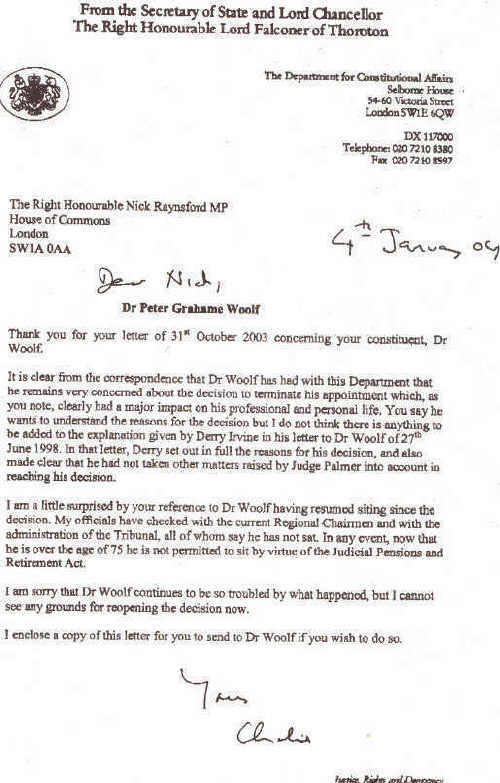
Having considered your latest correspondence I am afraid that there is little I can add to the Lord Chancellor's reply. - - so far as asking how many complaints have been - - made against medical members of the MHRT we do not hold such records here. That would be a matter for the MHRT. Also, you mention that you have not seen`: 12 November 2002 MTH to The Lord Chancellor It is perhaps worth pointing out that this move, which led to the inception of a formal complaints procedure for Mental Health Review Tribunal members (5th June 2002), was primarily provoked by Dr Woolf's seeking redress in his particular predicament. Sadly however, it remains the Society's conclusion that an evaluation of evidence conducted fairly and openly has been denied Dr Woolf and, because of this, his professional work record (we refer to that with the Mental Health Review Tribunal and to which he contributed so significantly over three decades) remains in his view, and in our own, unjustly tarnished at the whim of its then chairman. Our sadness relates not only to Dr Woolf's personal plight but also to the fact that your Office - -feels unable to grant him a formal hearing relating to his claim of unfair dismissal. This occurred within one of your own Office's departments (Mental Health Review Tribunal) which was regrettably deficient in what was even then already well established unfair dismissal legislation. Urging Dr Woolf to seek legal advice to pursue his claim (a potentially heavy expenditure at his advanced age) sits oddly, we submit, with the circumstance of his case involving as it does, one of the Lord Chancellor's departments. We still hope you will see your way to a reconsideration of his case. FROM THE RIGHT HONOURABLE THE LORD IRVINE OF LAIRG - - Dr Woolf is currently engaged in correspondence - - concerning the possible disclosure of information relating to his case. Whatever the outcome of the decision on disclosure I would still urge Dr Woolf to seek legal advice should he wish to pursue this matter. (Signed) Irvine of Lang 13 February 2003 KT to PGW The Lord Chancellor has asked me to say that, although he understands that you continue to be concerned about what happened, - - there is no Justification for reopening the decision. March 2003 SCP (DW) to The Lord Chancellor We certainly believe that he has a case and we have been disappointed that correspondence between Dr Woolf and your officials in his seeking basic openness has been characterised by prevarications, albeit polite, and delays (now totalling some seven years). Rather bafflingly, it now appears that Dr Woolf has established (12 th September 2002) that Mental Health Review Tribunals personal files maintained by the Department of Health in their MHRT office (and not available to their subjects) do not contain any documents relating to any complaints about him whether in 1994 or 1997. Given the apparent circumstances of this case, it truly appears that “Kafkaesque” is not hyperbole in this whole sad business. In general, Society members in their functioning as doctors, are regularly (and correctly) reminded by our lawyer colleagues about natural justice, rules of evidence and due legal process; the importance of reasons for their opinions and decisions. Much to our surprise and dismay all of these pillars of our justice system seem to have been overlooked in this matter. Because of your urging Dr Woolf to seek legal advice we feel we must once more appeal to your good offices, as Lord Chancellor, to help restore the good standing of this wronged man in this matter. 23 May 2003 KT to PGW - - You also asked us to confirm that our correspondence, whether by post or bye-mail, is not privileged and that we have no objection to publication of some of our letters. I can confirm that the correspondence is not privileged. - - it is a matter for you how you intend to proceed in the light of the concerns you have expressed. - - Your comment that the Judge “over-reacted grossly by ordering suspension" was dealt with in the Lord Chancellor's letter to you dated 27 June 1999 . In that letter he commented "I agree that if [he] did suspend your appointment in a manner which amounted to termination, this would have been incorrect, as I alone have the power to terminate an appointment . However, in the circumstances, this would have made no difference , in view of my decision that you should not be serving as a member of the Mental Health Review Tribunal". - - you have been informed that there is nothing further we can usefully comment upon in light of the Lord Chancellor's decision to terminate your appointment. That, I am afraid, remains the case - - Department for Constitutional Affairs I have been advised that the reference to paragraph 4 of Schedule 7 in my letter to you dated 13 February 2003 is incorrect. On reflection, no exemption should have been cited . The letter from Dr sic [R/Ch] is held on an unstructured manual file and therefore the subject access provisions of the Data Protection Act do not apply . - - I am sorry if I led you to believe that your right of access to any of your personal data contained in Dr P***r's letter was governed by the Data Protection Act. - - As the Data Protection Act does not apply in this case I have considered whether the information should be released to you under the non-statutory Code of Practice on Access to Government Information . - - Information held by departments in their capacity as employers is exempt, as is information in respect of individuals holding judicial appointments. I therefore refuse your request under exemption 8 of the Code (public employment, public appointments and honours). - - I am shortly due to leave my current post to take up other duties within the DCA. I am therefore copying this letter to my colleague [Ms MB], who has taken over responsibility for matters relating to the MHRT 31 October 2003 Dear Charlie Re: Dr Peter Woolf - 2a Vanbrugh Hill Blackheath, London SE3 7UF You will see from Dr Woolf's file that he has had a great deal of correspondence with the previous Lord Chancellor concerning his suspension from the Mental Health Review Tribunal. I believe that the core of Dr Woolf's argument has been somewhat lost through the vast amount of correspondence and would ask that, given your new appointment, this case is reviewed once again in its entirety. - -- - - I would ask that you review this case again as I strongly feel that Dr Woolf should be privy to any complaint made against him that has not been previously released. 4th January 2004 From the Secretary of State and Lord Chancellor The Right Honourable Lord Falconer of Thoroton to The Right Honourable Nick Raynsford MP
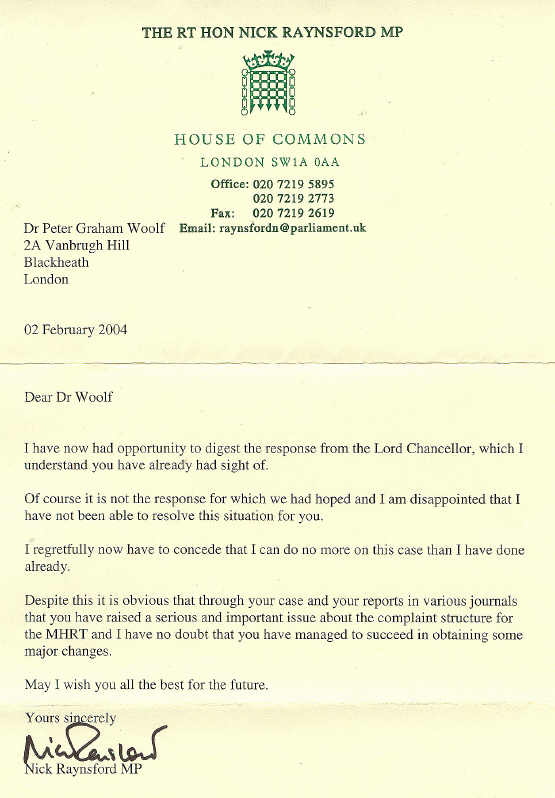
* The gratuitous reference to 'a little surprise' about my " having resumed siting (sic) since the decision ", and the irrelevant citing of the Judicial Pensions and Retirement Act, shows that the letter-drafter had regrettably neither absorbed the arguments, nor checked the papers - easily done direct with PGW, or by refreshing his memory of the representations to Lord Irvine - before this letter was placed before the new Lord Chancellor and signed, without anyone even checking for spelling mistakes! PGW 27 January 2004 (PGW to PLH, DCA) 27 January 2004 (PLH to PGW)
10 February 2004 (PGW to PLH, DCA) 10 February 2004 ( PLH to PGW) Any costs you incur are at your own risk. 25 May 2004 (PGW to PLH) The successive responses of the two Lord Chancellors have been felt not to address the cogent concerns advanced - - Surely you would consider this case serious enough to warrant investigation? If not, please would you let me know why not ? June 2004 (PLH to PGW) - - the current Lord Chancellor and his predecessor have considered your case - - There is nothing to add to the responses you have received - - Please direct any further correspondence to Jason Yaxley......... 16 June 2004 (JY to PGW) - - Once I have - - got my self up to speed with the issues I shall, of course, contact you - - I am already committed to spending most of next week at a MHRT induction event. 21 June 2004 (PLH to PGW) - - Thank you Peter. - - I have been involved in Mental Health issues on and off for 25 years, so like you feel frustrated by the lack of cohesive support structures - - Philip 14 July 2004 (JY to PGW) - - I do not believe that a meeting would be constructive or useful - - I am convinced that this matter has become a crusade for you - - all I can do is re-iterate the answers you have already received - - it remains a possibility that you will be classified as a vexatious correspondent . *
9 12 2004 KG to PGW I'm not sure how far you will get in attacking a decision to make a new system prospective only. What you may want to consider is approaching the current Regional Chair, Jeremy Cooper, and asking him if he will meet you and see if the matter can be approached with a fresh viewpoint and resolved. Failing that, there may be remedies available under the Freedom of Information Act. December 2004 PGW to JC (Regional Chairman MHRT) - - the Society of Clinical Psychiatrists [hoped for] an opportunity to comment on the draft of the revised complaints procedure - - my suspensions and subsequent bizarre dismissal must be regarded as ‘unsafe' until I have an opportunity to meet someone – anyone – in authority, which has been denied me throughout - the least I should be offered now is a meeting with you [or with your opposite number in the other Region] 18 02 2005 RS (DCA) to PGW - - I think the matter should be referred to the Lord Chancellor again - - it would be right for the Lord Chancellor to see the points you have raised since he last considered the matter - - I think the best I can do for you is to get the case to the Lord Chancellor - - I would be willing to meet with you after the Lord Chancellor has considered the case 14 07 2005 RS (DCA) to PGW - - I appreciate that you have been waiting a long time - - I will make arrangements to meet with you as soon as possible, by which time I should be able to report on the Lord Chancellor's views. 27 09 2005 RAY SAMS MEETING WITH DR WOOLF AND DR NIAS 1 10 2005 PGW to RS - - I do now recognize that Decisions by the Lord Chancellor cannot be challenged - - even when they contain demonstrable errors - - factual errors of this importance should have allowed for reconsideration or an appeal ? - - Your limited remit did not help to throw light on the existence of any “comparators” or precedents, or the nature of the evidence considered by Lord Irvine - - why Lord Falconer had not seen fit to take evidence from critically relevant witnesses, or why he had not responded to the urging from all sides that a proper review was fully justified? To my knowledge - - a medical member failing to recognize or declare knowledge of a tribunal applicant has never resulted in summary suspension from the MHRT - - let alone dismissal. It was issues such as this that we were hoping to discuss. 25 10 2005 PGW & DN to RS (from Notes of meeting 27 September 2005) Mr Sams reported that the Lord Chancellor had “carefully considered“ Dr Woolf's latest request for a further review of his complaint about Judge Palmer - - the outcome is that Lord Falconer was not prepared to interfere with Lord Irvine's original Decision to dismiss Dr Woolf from the MHRT, for the reasons Lord Irvine supplied in June 1998. Dr Woolf has been questioning the adequacy of those reasons ever since. - - Mr Sams explained that he thought it preferable to make the DCA's final position clear "eye to eye" rather than through the post. Dr Nias was invited to ask questions; he had accompanied Dr Woolf, both doctors anticipating a frank discussion of what had gone wrong and how it could be put right.Dr Nias questioned how could it be claimed that Lord Falconer had “carefully considered” the matter without 1. either of the Lord Chancellors having sought evidence from the Tribunal Members who sat on the occasion in question? 2. It was difficult to see how evidence from Judge Palmer alone could be accepted without checking, given the history of “personality clashes”? 3. Why was the extreme Decision of termination made, when the usual practice is apparently not even a suspension? 4. To justify the apparently extreme departure from usual practice, or at least put it in context, Dr Woolf was surely entitled to have sight of the first hand complaints against him and to know if there had been any precedents of suspension of medical members, let alone termination? 8 11 2005 RS (DCA) to PGW - - 9 11 2005 PGW to JT (DCA) We have read your note of the meeting carefully. Is Mr Sams prepared to confirm that OUR earlier summary of the meeting, which he has studied, is a fair one? 23 12 2005 RS (DCA) to PGW 6 January 2006 PGW to FoIA Formal Application to Freedom of Information Commissioner for disclosure of documents withheld - initially because of Data Protection Act (conceded non-applicable, 27 August 2003): " Neither the Data Protection Act nor the Code of Practice on Access to Government Information prohibits the release of information " - - c.f. Advice on prescribed form, which answers common queries: - - Q : Will I be able to get any information I want? A :Not always. The Act recognises that there will be valid reasons why some kinds of information may be withheld, such as if its release would prejudice national security or damage to commercial interests..... 19 January 2006 KH (The Information Commissioner, Customer Services Officer) to PGW - - before we can ask the public authority to respond to you, we will need a copy of the Information Request that you sent in 2005. Once we have this, we can ask the authority to respond to you. They should send you either the information or a refusal notice giving you the reasons. If they give you a refusal notice, they should give you details of their internal review/complaints procedure this is because this has to be exhausted before we can look at a complaint 2 February 2006 RS (DCA) to PGW Personal data, which is processed for the purposes of assessing an individual's suitability for judicial office, is exempt from disclosure under Schedule 7 of the Data Protection Act. Your request for information which relates to your dismissal as a member of the Mental Health Review Tribunal is therefore refused.- - the Information Commissioner (ICO) - - cannot investigate complaints about the Department's decision to refuse you information under the Code of Practice on Access to Government information 8 March 2006 KH (The Information Commissioner, Customer Services Officer) to PGW [Jan/March correspondence: perhaps readers can understand that eventual "clarification" on behalf of the The Information Commissioner ? PGW]
DN to PGW It will be interesting to see if he shows any sign of having thought about your questions. 23 May 2006 RS (DCA) to PGW 23 May 2006 PGW to DCA "I am afraid" implies fearfulness? What had Mr Sams to fear from answering my final round-up of questions honestly? Is he forbidden to do so? - - - - - - - - - - - - - - - - - - -
- - “ there is a tendency in some departments to use every argument that can be mounted, whether legally based, code-based or at times simply obstructive "You sometimes make mistakes and have to correct them" * * * * * * * " - - to this day- - not one authority has actually said sorry to us. Nobody has offered any help." “ All I want is for Blair to admit he were wrong and say Sorry! ” Government . . . restores lost trust above all by its willingness to attend to what lies beyond the urgency of asserting control . . . by patient accountability and the freedom to think again, even to admit error or miscalculation. It is necessary that all governments be checked, Earlier this month the constitutional affairs secretary Lord Falconer said that 'An ordeal like mine either makes you or breaks you. They tried to crush me, but I wasn't having it. - - There's just me and this huge system, and over the years, I've got it in disarray. - - The system conspires to uphold itself. Maurice Frankel Director, Campaign for Freedom of Information September 2004 Opening up Whitehall and introducing freedom of information is a vital task - and vital that it succeeds. It's essential that government finally embraces openness. The benefits of open government are clear: Sir: I welcome your focus on the Freedom of Information Act. But it is emphatically not the case that officials can simply deem it "not in the public interest" to provide an answer to an information request. There is a presumption of disclosure - - the Act expressly talks about the public interest in disclosure. In most cases, information must be disclosed where this outweighs the competing public interest in an exemption. So public interest considerations can secure greater openness, not justify secrecy "if all else fails". In any event, my office stands ready to consider complaints that an exemption has not been properly applied or - where relevant - that the public interest in disclosure has not been fully considered. - - anyone applying for information must be prepared for uncompromising bureaucracy, - - " once an error is made, the unspoken rules say that it must be persisted with, L et the penalty fit the crime Persistent questioner is barred Hindsight Corner Wise and prophetic words have been offered from time to time, discounted and (it may be thought) foolhardily ignored. But on the way between 1997 and 2006 there's been a lot of eye-opening discovery about defensive government! JW (Chairman of MHRT Regional Chairmen's Committee, and Honorary Fellow of the Royal College of Psychiatrists) to PGW, July 1998: Observations by a Consultant Clinical Psychologist: What remains very much at issue is how the whole matter was handled, e.g: - When you appealed against not being given a proper reason, why was the LC letter not cited and carefully explained? That could have led to discussing the practicalities of Tribunal work versus keeping to the "ideal" principles of "good practice". Should you have been given more of a chance to respond to the accusation? - What is the evidence that you refused to recognise the principle of a potential conflict of interests? Would it have made a difference if you'd given in and admitted that they had a point - albeit a hypothetical one? Perhaps you were the first not to give in! Why were examples of previous cases of a similar nature not cited, if there had been any? - did your case set a legal precedent?- The important issue from the LC's standpoint appears to have been your reluctance to humbly accept the principle (hypothetical or whatever) that he was making. You seem to be a victim of the need to "tow the party line". The official line seems to be that one must pretend to work to the "ideal" even though at the same time it is necessary to be "sensible". ("Likelihood" of conflict of interest implies more than a remote, infinitesimal "possibility".) - This sort of discussion should have preceded the final and unappealable Decision of the LC. Better that, than to have put themselves in a position where to back down would have been to lose face. - At the very least someone should have met with you before the Decision was made to explain why, after months of delay, the LC department was not happy. - - if the argument had been put to you directly and you'd have bee n able to address the issue right at the outset , things might have turned out entirely differently. I agree with David Nias's comments on this. (Maurice Frankel, Director Campaign for Freedom of Information ) * * * * * * * Futher reading: Richardson, G. & Machin, D. (2000) Doctors on tribunals - A confusion of roles British Journal of Psychiatry , 176, 110-115 Rooth, G. (2001) The future (or not) of the medical member Psychiatric Bulletin, 25, No. 1. Society Of Clinical Psychiatrists Study Group (1988 ) A Code of Practice for suspending Hospital Doctors British Journal of Clinical & Social Psychiatry 6, 94 Woolf, P. G. (1991) The role of the doctor in the Mental Health Review Tribunal Bulletin of the Royal College of Psychiatrists , 15 407-409. - - - - - (1999) Serving the MHRT 1966-98 Psychiatric Bulletin, 23, No. 4. - - - - - (1999) Inside the Mental Health Review Tribunal British Journal of Clinical and Social Psychiatry , Vol 10 No 1. - - - - - (1999) Discipline in Public Service Justice of the Peace Vol.163, No.26 - - - - - (2003) Openness Denied – Excessive Government Secrecy? Justice of the Peace , Vol.167, No.38. - - - - - (2003) Think twice before you serve on a tribunal Hospital Doctor, 17/04 - - - - - (2005) Book Review Your Right to Know (SCPNET)
November 2003; last updated 2006 With thanks to all the many doctors and lawyers, tribunal members and others who have helped with support and advice; especially to Dr Dermot Ward, Chairman of SCP, for encouragement with this publication, with representations to the Lord Chancellor and for accompanying me to a meeting with the BMA; and to Dr David Nias for assistance with the bibliography, and at meetings in the Department for Constitutional Affairs and with the Campaign for Freedom of Information. To repeat! Readers observations , including any corrections will be welcomed
|