|
Blackheath Sundays 15 May 2005
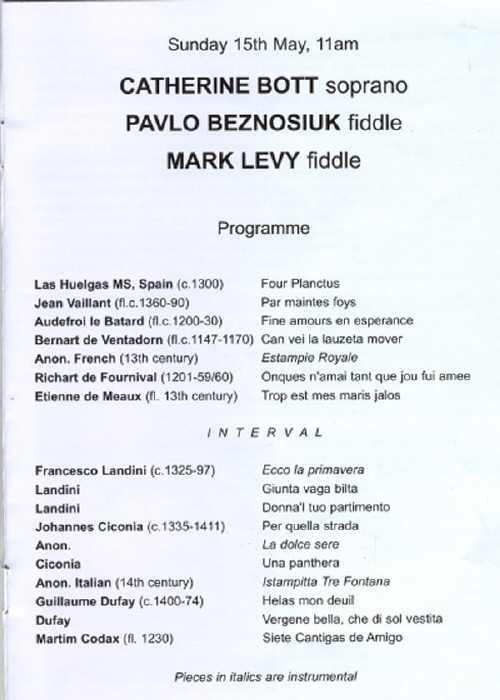 A bright spring Sunday morning saw this illustrious trio of early music specialists bring to Blackheath a programme that took the audience from Spain to France to Italy and finally back to Spain, finishing with a haunting song cycle from the Martim Codax. A bright spring Sunday morning saw this illustrious trio of early music specialists bring to Blackheath a programme that took the audience from Spain to France to Italy and finally back to Spain, finishing with a haunting song cycle from the Martim Codax.
The recital began with the Four Planctus form the Las Huelgas MS, laments taken from a manuscript from a convent close to the pilgrim route to Santiago de Compastella. Catherine Bott’s singing emphasised the melismatic nature of the word settings, with the fiddlers providing improvised accompaniments.
Spring was celebrated in the ‘Par maintes foys’ with the depiction of birds fighting over the most verdant territory before the recital moved into the celebration of courtly love with songs from the troubadour/trouveres tradition.
The first two songs featured lovelorn pieces from the man’s point of view and after a break for a dance in ‘Estampie Royale’, the woman’s point of view was expressed in the less lovelorn and more practical songs by Fournival and Etienne de Meaux. Miss Bott described these songs as being a song of loss in the first case-if only she had let him into her bed he might not have left her- and a song form the genre of songs of ill-marriage in the case of the latter-her husband is jealous (and with good reason as she is not satisfied by him).
The second half opened with the instrumentalists providing a fanfare welcoming spring, before the trio performed the beautiful melodies by Landini and continued with songs described by Catherine Bott as ‘grovelling’ songs, songs written for patrons that required flattery. This was an area that the Franco/Flemish composer Johannes Ciconia was adept in.
Pavlo Beznosiuk and Mark Levy then displayed considerable virtuosity in Istampitta Tre Fontana, a dance that required repeats in a pre-arranged order, demanding memory and dexterity. Unlike the dance piece in the first half, this music was more suited to close listening than to exuberant movement. The instrument used were fiddles, copies of medieval originals, tuned in 5ths and 4ths, described by Pavlo Beznosiuk as having their root in plucked instruments and sometimes being made with flat bridges. Mark Levy played his fiddle with the instrument resting on his lap.
The recital finished with two songs by Dufay, the second a setting of a Petrarch Sonnet and then the highlight of the Siete Cantigas de Amigo. This song cycle describes a girl waiting for the return of her love from the seas and the music mirrors the ebb and flow of the sea and this mirrors the girl’s hope and despair. The music for the sixth song is lost and Catherine Bott read the words. The effect of the music is almost shattering. Her lover is not going to return.
This was a superb recital in which a full range of emotions was experienced. Miss Bott, as befits a distinguished broadcaster, is a superb communicator and her linking of the material helped to bring the music to life, as can be seen in this review and from the reaction of the reviewer. The good news for those unable to attend this special recital,is that there is a forthcoming Hyperion CD which covers the bulk of the material.
Mark Dennis
|