 |
 |
|
 |
||
|
Poulenc – The Carmelites
English National Opera 5 October 2005 Conductor – Paul Daniel Director – Phyllida Lloyd Designer – Anthony Ward Lighting – Hugh Vanstone
Marquis de la Force – Ashley Holland Blanche de la Force – Catrin Wyn-Davies Chevalier de la Force – Peter Wedd Prioress Mme de Croissey – Felicity Palmer Mother Marie – Josephine Barstow Prioress Mme Lidoine – Orla Boylan Sister Constance – Sarah Tynan Chaplain – Ryland Davies
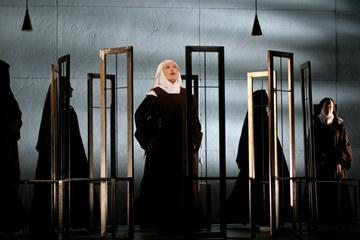
Catrin Wyn-Davies (photo: Stephen Vaughan) “An historic testament to Catholic faith and martyrdom” is the wording on ENO's poster and it is an apt description of this still controversial opera.
It is a matter of historical record that sixteen Carmelite nuns from Compiegne were executed in Paris in 1794. Their sub-prioress, Mother Marie of the Incarnation, survived to outlive the regime and leave a full written account which formed the basis of a novel by Gertrud von le Fort. Mme de Croissey, the prioress, was a real person as was her successor Mme Lidoine, but the aristocratic de la Force family are fictional characters added to flesh out the story, which begins with the daughter, Blanche's announcement of her intent to join the convent. Georges Bernanos turned the novel into a play and film script, the basis for the libretto.
Phyllida Lloyd's production, first seen at the Coliseum in 1999, was a co-production with WNO and Anthony Ward's sets – a series of sliding screens – had to fit the smallest of WNO's touring venues. Nonetheless, they look good in the “letterbox” format of the Coliseum stage and their simplicity fits well with the austerity of convent life – indeed the depiction of the domestic aspects of community life is one of the great strengths of this production.
The characters of the nuns are very strongly drawn in the libretto and music: The hyper-anxious Blanche, always fearful, contrasts with Constance, the other novice, who cheerfully accepts her premonition of their early death. The seemingly rock like Prioress, whose faith deserts her in an agonising death scene, is similarly contrasted by Mother Marie stepping in to restore calm, and Mme Lidoine who quickly establishes her authority as the new prioress. The Reign of Terror is closing in on the order, Their gentle and warm-hearted chaplain must go into hiding, the church is vandalised and the nuns take a vow of preparedness for martyrdom, and Blanche flees in terror to the ruins of her home.
Poulenc himself chose the singers for the 1957 Paris premiere and attended many of the rehearsals. A studio recording by the original cast is still available (EMI Classics 5 62751 2: Duval, Crespin, Scharley, Gorr, Berton, cond Dervaux) so we have a direct reference to the voice characteristics the composer wanted. ENO's cast have mixed success in matching these requirements. Catrin Wyn-Davies [pictured] introduces a slight edginess of tone which captures Blanche's proximity to hysteria, Felicity Palmer gives a hair-raising performance as the dying prioress, Orla Boylan has the strength and dignity of tone for Mme Lidoine, and Sarah Tynan has all the qualities one would wish for Sister Constance. Ryland Davies (the Chaplain) and Josephine Barstow (Mother Marie) are superb actors and their singing technique has been polished by years of experience, but sadly their voices no longer do full justice to Poulenc's demanding score.
The final and crucial scene is the execution. The nuns chant Poulenc's setting of the ancient Latin anthem Salve Regina (Save us, holy queen, mother of mercy …). One by one the nuns process to their death as the orchestra imitates the sound of the guillotine falling onto the bock. The singing grows proportionately fainter until only Constance remains and suddenly Blanche appears to join her. The libretto indicates that Blanche has been hiding in the crowd, but ENO play the scene with an empty stage. Arguably, the drama is heightened if both Blanche and the survivor Mother Marie are visible to the audience as part of the crowd, hesitant as to their next move and destiny. Either way, the music portrays a grisly but spiritually uplifting ending.
Serena Fenwick
Note: In Joseph Machlis' English translation, as heard from mid-Dress Circle, far too many of the words were lost, and there were no sur-titles, which contributed to making the first half (one and a half hours) feel too long (one of the orchestral players told me that he thought Poulend had authorised cuts, and he wondered if they should be tried?). Of the conflicting reviews, I felt closer to The Times reviewer who felt "the merest prickle in one eyeball" at what should be "a climax of unbearable intensity"; I found that final scene completely unmoving. This production will be recorded for CD later this month; perhaps it will be more effective left to your imagination? PGW
|