|
Laban & Palucca
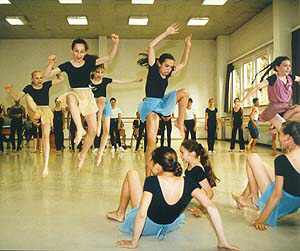
Contemporary Dance Students from London and Saxony
at Laban, Deptford 11 February 2005
SERENATA* This solo work, premiered 1932, marked a high point in the public acceptance of the pioneering dancer, Gret Palucca.
CHOREOGRAPHY Gret Palucca
DANCER Mareike Franz
MUSIC Albeniz - Granada
TESTBILD-ENGERLINGE
CHOREOGRAPHY Anke Glasow
DANCERS Sarah Agde, Juliane Bauer, Undine Forster, Johanna Gebauer, Soo-Jin Lee, Maggie Nicolai and Sophia Randier
MUSIC Jean Marc Zelwer
Class at Palucca
KEITH
CHOREOGRAPHY Birgit Scherzer
DANCERS Timo-Felix Bendszus, Rene Klotzer, Philipp Kruger, Stephan Muller, Christian Schreier, Sebastian Uske and Noala de Aquino
MUSIC Keith Jarrett (Cologne Concert)
SOLOS FOR TWO
Solos for two is a series of parallel duets drawing together the
mirroring image of relationships.
CHOREOGRAPHY Stephanie Schober
PERFORMERS Alice Downing, Matthew Howells, Claire Hudders, Torill Mjelde, Alexandra Nicholls, Maira Paunonen, Daniel Pope, Mandeep Raikhy, Kerstin Rosemann, Anne Schonwalder, Fiona Skene, Teresa Szymkowicz, Veera Westerholm, Hannah Wheeler
BREAK/DOWN
CHOREOGRAPHY Rosalind Newman
PERFORMERS Hannah Brittain, Jane Coulston, Alice' Downing, Natash,a Gibbs, Matthew Howells, Claire Hudders, Maria Paunonen, Melanie Pepper, Helen Rust, Anne Schonwalder, Fiona Skene, Jamie Smith,-Alice Sunderland, Teresa Szymkowicz, Pamela Wainwright, and Veera Westerholm
MUSIC Meredith Monk
This joint event, the culmination of a rewarding two days workshop with students of Laban and Palucca, Dresden (the only contemporary dance conservatoire in Germany) marked the opening of D Saxony UK 2005, a series of projects in which Saxony is presenting itself in the UK (in London, musical events at the Goethe-Institut, German Embassy and Royal College of Music). An introductory talk drew connections between the two pioneers Rudolf Laban (1879-1958) and Gret Palucca (1902-1993).
It made for a good evening. The London based contingent (they are always of international mix) gave first an ambitious (and overlong?) silent dance work Solos for Two in which changing parallel pairs, dancing in spotlit
squares, hinted at subtle, changing relationships, but although the movements were generally interesting, the piece as a whole seemed too diffuse and unfocussed. Break/Down appeared to be a study in balance, and exploited small grey 'bricks' which were shuffled around and used as stepping stones; a useful class study exercise, no doubt, but limited as theatre entertainment and not helped greatly by the background music.
The Dresden half had begun with a historical revival of a pioneering piece by their founder, evocatively danced by the beautiful Mareike Franz*. The girls continued the Spanish theme and entertained with a piece underscored by music that had elements of Bolero/Fandango. The high spot of the evening was the display by the young men from Germany (only about 18 they were, we were told) who danced with energy and impressive skill a work depicting fluctuating bonding relationships (and exclusions) in late adolescence. The movements were driven purposively by the famous Jarrett recording of his 1975 Cologne Concert and a final coup, the alluring high-heeled Noala de Aquino proudly walking across, caught all eyes on stage and in the audience.
Laban &Portugal
Movimento5 at Laban 6-10 December 2005
Laban joined with Trinity College of Music in August to consitute a leading force for music and dance in the Metropolis, "Laban Trinity".
Musical Pointers has for some years now been including occasional coverage of the public performances held regularly in the famous new building's Bonnie Bird Theatre, and this month there is to be seen there the results of collaboration with Portugal.
Movimento5 is the second annual showcase at Laban of Portuguese contemporary choreography, supported by the Calouste Gulbenkian Foundation.
Tânia Carvalho:
A silent explosion is not quite disturbing and I walk, you sing
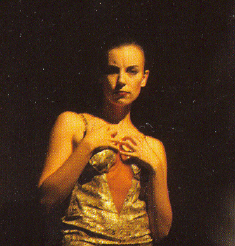 This was a short but potent programme with first a solo by Tânia Carvalho 'A silent explosion is not quite disturbing', about the impotent, private struggles of a woman seemingly imprisoned in her life as a housewife This was a short but potent programme with first a solo by Tânia Carvalho 'A silent explosion is not quite disturbing', about the impotent, private struggles of a woman seemingly imprisoned in her life as a housewife
She was rooted to the spot, metaphorically, with a pair of white Stone Shoes, her arm movements jagged and inrreasingly frenetic, with episodes of stasis with her body bowed to the ground. Having conveyed her despair she finishes by putting on her public face at the end, expressing a false sense of stoical serenity, as if nothing was wrong....
It was followed with I walk, you sing, an absorbing new subversive work about isolation and communitydeveloped by Tânia with the Sadler's Wells' Company
of Elders (Over 60s Performance Group). Going against traditional ballets' fixation with pubescent bodies, it was a pleasure to spend half an hour with this group of supple middle aged women such as rarely grace the dance/ballet stage, and who expressed their feelings about life with humour and resignation.
Both works were distinguished by adventurous choices of music, right up 'our street'! We heard vocal music reminiscent of Scelsi's (in quest of whom we went to a Gulbenkian Festival in Lisbon a few years back) and some Bach, Beethoven and Mahler heard in versions by Glen Gould and Uri Caine, a "cross-over" composer championed by us for some years.
Francisco Camacho Existential Divide
This was a complex and fully engrossing work developed and performed with some twenty Laban students during a five-week residency. The stage was opened up to its fullest size and we watched a fragmented panorama of young dancers locked in their own very individual personalities and personal stories, of which they disclosed fragments by movement, facial expression and occasional sound and utterances, couples coming together from time to time in transient sexual engagement... What came across included humour and violence, all expressed with telling body movement, with a little Portuguese music occasionally.
Compulsive watching, a picture of the urban human condition of today's young people, obliquely introduced by a gnomic note: "A work, an object, a piece of architecture, a photograph, but equally a crime or an event, must be the allegory of something, be a challenge to someone, bring chance into play and produce vertigo". I can't do better, but it fits somehow. We were not privy to the meaning of what we were watching, and the people on stage were unknowable.
The power and intensity of Carvalho and Camacho's conceptions whetted the appetite for the last programmes of the new Portuguese choreographers.
See also the Company Miguel Pereira's ground-breaking Corpo de Baile and Antonio Miguel which promised and delivered all manner of wonders....
If you're within range of Deptford, it's definitely worth checking out the programmes at Laban, but also wise to enquire about the length of an evening's offerings before making a long journey there. The Carvalho and Camacho items totalled about 65 mins on stage and would have made an ideal triple bill but, for logistical reasons no doubt, they were spread over two evenings.... Living close by, no problem for us, and we got home in time to see Harold Pinter's devastating Nobel Prize acceptance speech on TV.
See also
* An account in danceviewtimes of Palucca’s Serenata, from a review of the Palucca School's performance in Berkeley 2004, is reproduced below:
Maria Zimmermann performed Palucca’s lovely Serenata, a piece from 1932 which Palucca was seen performing in a film on her, shown at Stanford in conjunction with the live performance, the day after the Berkeley appearance. - - The airy Serenata opened with an illusion of going back and forward simultaneously as one arm pushed slowly ahead and the rest of the body rocked back and forth. Stretched up and space embracing, the dancer seemed to travel the air around her, punctuating the liquid patterns with moments of quiet intensity in a slow descent to the ground, one leg stretching behind her or displaying herself in semi profile, arms overhead as if holding a pot overhead. Designed to convey a sense of spontaneous response to the music, the piece also bore echoes of women’s gymnastics of the time and even, the much rejected Isadora Duncan. Serenata ended with a simple assertive gesture. The dancer put her flattened hands on her thighs. They looked like punctuation marks.
|