 |
 |
|
 |
||
Mozart
The Magic Flute 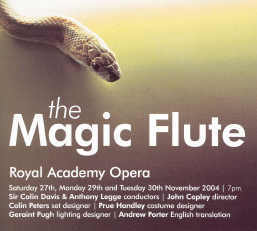 Sir Jack Lyons Theatre, Royal Academy of Music, London, November 27, 2004 Sir Jack Lyons Theatre, Royal Academy of Music, London, November 27, 2004
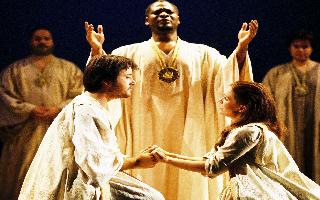
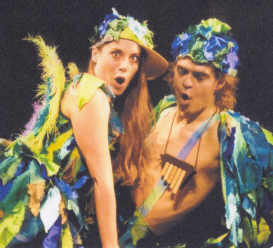
Pamina – Jane Harrington Royal Academy Sinfonia & Chorus/Sir Colin Davis The multi-national cast of Royal Academy Opera put across "The Magic Flute" in Andrew Porter's English translation (Mozart intended it to be heard in the vernacular) with admirably clear diction, notably so Viktor Rud, whose Ukrainian accent brought both charm and topicality into his scene-stealing assumption of Papageno, the best part in the show, the character with whom a modern audience can most easily identify, pictured below with his charming Papagena Costumes were well designed, but the minimal stage props signified a very tight budget, and did not have the interest of the scenery afforded by the late lamented Gubay presentations at The Savoy Theatre. This evening provided for me a startling example of the crucial importance of seating position. We were allocated the side of Row 4, just as the same as the end of the fourth row which served us excellently at RCM's Rape of Lucretia the previous evening. At RAM, I found an equivalent position almost intolerable; the Jack Lyons Theatre, (comfortable and with good sight-lines) has, I think, a more difficult acoustic than the Britten Theatre. The strings sounded brash and over-bright, and the singing often over loud for a small opera house. I found myself seriously disenchanted with the visual goings-on during the first act, and especially irritated by the continual rotation of the all-purpose boxes which After the interval I found what seemed to be the only unoccupied seat; right at the back under an overhang (normally to be avoided). The transformation was truly Magical. The sound there was warm and perfectly blended between pit and stage, so that one could then appreciate the subtleties of Sir Colin Davis's always helpful conducting, and the whole thing had a totally different 'feel'. Robert Winslade Anderson was a noble Sarastro, a bass of great potential, and Jane Harrington and Michael McBride carried their leading roles with dignity and easy vocal delivery; Nicholas Mulray scared Pamina (and himself) convincingly. Some of the singing may have been actually better after they had warmed up, notably the Queen of the Night who hit her high notes accurately in her second act aria, although I still found Especially noteworthy was the fluent movement of the Three Boys, small female students whose singing blended perfectly as they came in to prevent disaster in the nick of time (roles of particular interest to me, because my son Simon Woolf had played Second Boy and then been promoted to First Boy at successive Royal Opera runs). One should never forget that when critical responses read as seemingly perverse, and at odds with one's own experience of an opera or concert, the explanation may lie to a surprising degree with seating positions in theatre or concert hall.
|