| 
Nicolas Maw at 70
Wigmore Hall, 5 Nov 2005
Flute Quartet:
6 Interiors:
Music of Memory:
String Quartet No. 3
Emanuel Ensemble
Philip Langridge (tenor)
Stephen Marcionda (guitar)
Zivoni String Quartet
Now living in USA, the British composer Nicholas Maw's carrer has fluctuated in esteem in his native country. The vast "Odyssey Symphony", as I called it, was a high. It has had too few performances; Odyssey deserves a place in the repertoire alongside the full-evening symphonies of Bruckner, Mahler and Havergal Brian.
The opera Sophie's Choice on the other hand disappointed many of us and did little for Maw's reputation.
This was a well planned chamber music survey, well attended
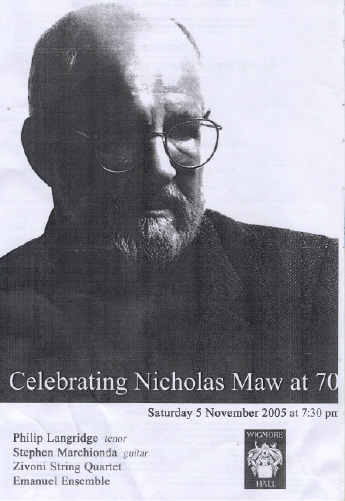
and in the presence of the composer who, when he came onto the platform at the end with all the artists, looked far nicer than in this discouraging publicity photo.
It is reproduced here from the photocopied programme supplied at the interval; Wigmore Hall had run out of programmes before the concert, so some of us were without words for Maw's Hardy songs, and as so usual (even with singers like Philip Langridge who are careful with their diction) one only caught odd words and phrases, never the whole import of the poems.
Perhaps we were better without them; they are unremittingly bleak and pessimistic - what does their choice imply about Maw's feelings upon achieving his Bilblically-allotted life span?
And even if we had our programmes, there was no way to follow them, because the hall was plunged in darkness throughout, without the lights even being put on between items during platform re-arrangements.
This is one of the most bizarre of common practices these days; during the intervals everyone deplores it, to no avail. Chamber music surely developed from a shared social experience, typically with a small number of musicians and their friends. Why destroy that for an illusion of "atmosphere"?
The flute quartet last around half an hour and is a deliberate (rare) attempt to provide a major statement in three substantial movements to set alongside the great works for clarinet and strings. It is undoubtedly discursive, and (having no programme notes to read) I thought the first movement might have been the whole. I also wondered afterwords whether the lento second was sufficiently contrasted with the previous moderato con moto. I look forward to hearing it again on CD however, with the original dedicatee Judith Pearce [ASV: CDDCA920].
The second half was decidedly better. The substantial guitar solo Music of Memory is an attractive meditation upon a theme from Mendelssohn's lovely Op. 13 String Quartet (their worth has been newly realised during my listening lifetime, partly because of the advocacy of Hans Keller). Nicholas Maw is an unrepentant contrapuntalist and his own String Quartet No.3 in one movement (1994) was, for this composer, relatively concise and a compelling conversation between four friends; his quartets ought not to have practically disappeared from recital programmes.
Photo: Maurice Foxall
|