
 |
 |
|
 |
||
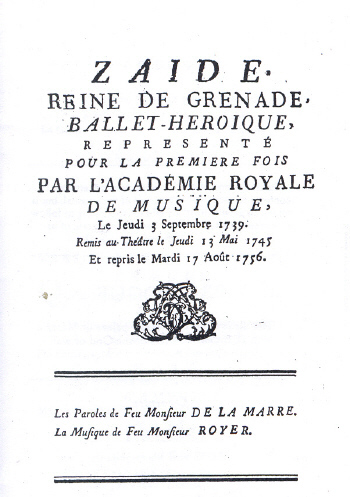
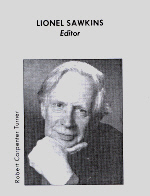
Royer Zaïde, Reine de Grenade St John's Smith Square, London 15 October 2005 NONSUCH SINGERS The name of Lionel Sawkins, who edited this opera for performance and composed the missing inner parts for several choruses, is currently more familiar to music lovers (and, especially, to record collectors) than that of Joseph-Nicolas-Pancrace Royer (1705-55), who is best known for his extravagant harpsichord pieces worked up from his operas (e.g. La Marche des Scythes). Sawkins' programme notes for this concert are ©1992, 2005, so I shall not venture out onto the quicksands, quagmire or minefield that will have been at the back of the minds of some listeners to his pre-concert talk. I limit myself instead to welcoming Zaïde, Reine de Grenade (1739) as a very viable and enjoyable opera, carefully prepared in 18th-century pronunciation and given by an accomplished and well balanced team of young singers, supported by Grahame Caldbeck's expert chamber choir and the admirable Oxford-based authentic instrument orchestra The Band of Instruments. The soloists were well balanced, although Jacques Imbrailo was a little too inclined to bluster (not always inappropriately) and Daniel Auchincloss was only able to take his eyes from the score momentarily. Jeni Bern was generally fine as Zaïde but muted some dramatic opportunities, Sophie Bevan delightful as her slave Isabella. Sawkins emphasised the light-heartedness of the Prologue, but Graham Caldbeck seemed confused about when to allow or discourage applause during the long evening. Sawkins had largely confined himself to repeating parts of his concert notes, permitting Lisa Goode Crawford, noted American musicologist and harpsichordist, only to content herself (and tantalise the audience) with but fragments of a couple of the harpsichord pieces. We were told that by special request the lights would remain bright for us to read the bi-lingual texts during the concert; in the event, they were dimmed, but not too much. One could manage to read the English paraphrase more easily than the French facsimile of 1756. The audience was deplorably small for an auspicious London premiere. It was being recorded for the Nonsuch Singers archive, but in the present climate may not reach the public as a CD? Zaïde, Reine de Grenade is well worth considering for a staged performance, in which the characterful entractes and dances would find their proper place. Lisa Goode Crawford is Professor of Harpsichord at the Oberlin Conservatory of Music and a member of the renowned Oberlin Baroque Ensemble, She has edited the keyboard music of Pancrace Royer for Heugel (Paris) and has recorded solo works of Royer and Rameau for Gasparo Records. With Mitzi Meyerson, She was appointed chercheur associé at the Centre de Musique Baroque de Versailles to study and edit opera-ballets by Pancrace Royer to direct the project and serve as musical director for the staging of Le Pouvoir de l'Amour. Times2 October 18, 2005 (Richard Morrison at St John's, Smith Square) Because he was tidy-minded enough to die 50 years after he was born, the French composer Joseph-Nicolas-Pancrace Royer has both a 300th and 250th anniversary this year. So it is probably now or never for his “ballet-héroïque”, Zaïde Queen of Granada - - Saturday’s performance came courtesy of a new edition by Lionel Sawkins — whose picture and biography were given hilarious prominence in the programme - - what really makes Zaïde worth reviving is Royer’s lilting triple-time tunes, his sparse but sensuous orchestral textures with flutes and oboes very prominent, his exuberant choral writing and his fluid treatment of recitative and aria - - It’s hard to believe that it comes from the same era as Handel’s grandiose arias. This performance needed more Gallic elegance in the phrasing, and a good deal more colouring of the text by some soloists. Too many eyes seemed glued to the dots. Jeni Bern safely negotiated most of Zaïde’s challenging runs, but never mustered enough regal tone - - it was the 22-year-old Sophie Bevan who most often caught the ear: a rich, clear, tuneful soprano with apparently huge reserves of power. Remember the name. Graham Caldbeck obtained neat if occasionally anodyne playing from the Band of Instruments, and the Nonsuch Singers - - never faltered in intonation or tone.
|
 possibility of questions from the audience!