SCHUMANN Overture to Genoveva; Nachtlied
BRAHMS Ein Deutsches Requiem
Orchestra of the Age of Enlightenment & European Voices/Sir SIMON RATTLE SUSAN GRITTON soprano DIETRICH HENSCHEL baritone
ROYAL FESTIVAL HALL 15 DECEMBER 2003 and Radio 3 from Birmingham 16 DECEMBER
An untraditional, secular meditation for the bereaved, Brahms chose the biblical texts of his German Requiem for musical reasons and without Christ's name ever mentioned.
The clean, sharp textures of OAE's period instruments made wondrous sounds as heard from the front of the Terrace Stalls and one could not wish for the more usual upholstered sound of full modern orchestra and a larger choir. It was revelatory in the exposure of detail, and Simon Rattle kept a feeling of movement with underlying pulse so that the whole was not a sombre experience. Both soloists were impressive, Susan Gritton's poise and steadiness especially so, coming in cold after sitting patiently for half an hour.
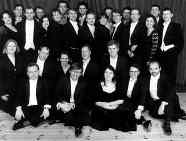 My illustration is of Simon Halsey's European Voices, a professional choir of between 20 and 80 voices (about 45 on this occasion) keen and bright whether in pianissimo or full-throated. They blended to perfection with the lean OAE and there were many moments of aural magic, such as combining with the solemn brass in the climaxes of "For all flesh is as grass.". My illustration is of Simon Halsey's European Voices, a professional choir of between 20 and 80 voices (about 45 on this occasion) keen and bright whether in pianissimo or full-throated. They blended to perfection with the lean OAE and there were many moments of aural magic, such as combining with the solemn brass in the climaxes of "For all flesh is as grass.".
How it came across to different parts of the hall is for others to tell? For me it was musically uplifting, if not so emotionally intense as other performances remembered.
It was preceded by a brief choral setting of Friedrich Hebbel's Nachtlied and the overture to Genoveva, which had one feeling that the opera must surely be more interesting than its neglect warrants?
Responses to musical performances are both subjective - so do other reviews of the two Schumann/Brahms concerts with Rattle & OAE testify* (Musical Pointers was not invited to cover the first one) - and they depend on listening situations to a remarkable extent, ignored by most writers.
I was pleased to see that the repeat of this choral concert was broadcast last night from Birmingham. But the magic did not reach me again through my (five) loud speakers, however much I tried adjusting the complicated controls between the options offered; Hall, Theatre, "Pseudo Surround" etc..... Did the trouble lie with the warmer acoustics of Symphony Hall, or with the radio engineers?
Daniel Barenboim is eloquent and thought provoking in his discussions with Edward Said, Parallels & Paradoxes p.29 (Bloomsbury) "for the people who are there at the concert, it never comes again". The Radio 3 broadcast left me grateful to have experienced this recreative experiment by Sir Simon Rattle & the OAE live, and at our often denigrated Festival Hall in London.
- - a revelatory account of Brahms's Ein Deutsches Requiem . Here Rattle's uncanny ability, as it were, to breathe structure in naturally unfolding spans when the heights and depths of his musicality are fully engaged came into its own. The grainy strings and pungent winds of the OAE truly served to clarify the richly Brahmsian textures that modern orchestras so often homogenise and clog up. Simon Halsey's expert training of his 44-member European Voices paid off in choral textures of immaculate balance and expressivity. With the soprano Susan Gritton exquisitely phrasing her "Ihr habt nun Traurigkeit" and intense, focused contributions by the German baritone Dietrich Henschel, this performance lacked only for sonorous bloom in the miserable RFH acoustic. (Bayan Northcott)
*See also Classical Source and Guardian
|