
 |
 |
|
 |
||
|
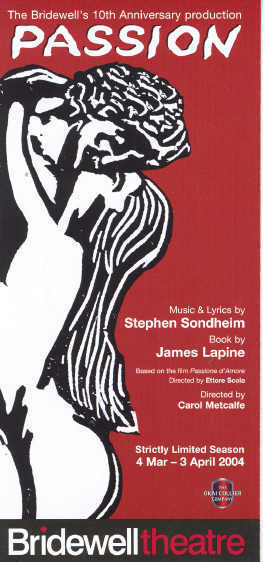
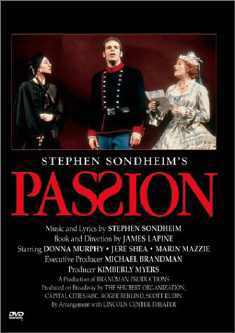
Stephen Sondheim's Passion Bridewell Theatre, London 5 March 2004 The sentimental story comes from a novella "Fosca" by Iginio Ugo Tarchett, seen by Sondheim in a filmed version. We both found it in the main mawkish and unconvincing, with the lyrics and tunes of the vocal numbers less memorable than those of almost any other Sondheim show. Passion takes its story of military love affairs in Italy altogether too seriously and we never became engaged in their outcomes, which seemed to be on a downward slope from the pseudo-ecstatic nude coupling with which it commenced. No witticisms are admitted to recounting this dour tale. An intimate story with a relatively small cast, it should have been suitable for this favourite fringe theatre. Passion opens with two lovers in bed, the man nude, the woman nearly so, singing about their happiness which we know won't last. Kate Arnell (Clara) has a quavery voice and doesn't sing very well. Mark Carroll (Captain Giorgio) is the anti-hero who cannot please anyone. He holds the centre of the action, mainly agonising about what he ought to do in relation to two impossible women. Clara won't leave her family for him; Fosca (Clare Burt) 'a homely, sickly woman who has never been been taught how to love' keeps going into hysterical fits and gradually traps and seduces Giorgio before she dies of a mysterious illness. The doctor (Simon Masterson) drives the always predictable tragedy. One review of the American DVD of Passion (Region 1 encoded) applauds how Stephen Sondheim and James Lapine 'solve one of the main problems of enjoying the show' with their camera, which 'provides the requisite sense of intimacy that makes this story a more powerful experience because we are spared the distance of watching it from the seats', presumably in a large Broadway theatre. But that is not a problem at the Bridewell's converted old swimming pool, where musicals usually do well with a reduced band. But this time, Stuart Barr's arrangement of Passion for five instrumentalists packs no emotional punch; perhaps the story of Clara, Giorgio and Fosca is one that calls out for full tragic romantic opera treatment?
|
 He is a sinister figure, but one whose motives remain undefined.