 |
 |
|
 |
||
|
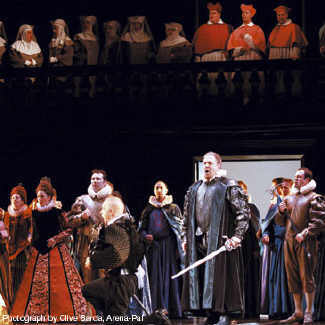
Verdi Ernani (ENO revival, Coliseum, London 18 June 2004) This was far better than the earlier reviews had led one to expect; take your choice from the wide selection on The Opera Critic! Mark Shanahan had the orchestra playing idiomatically and with some passion. The lead singers were all satisfactory to good, Cara O'Sullivan the focus of all the male attention, Alistair Miles taking a little time to find his best voice. From our preferred position, side stalls, far back, the diction was excellent; the best argument for surtitles at ENO is the variability of audibility in different parts of the Coliseum, and not just according to cost of seats. Although Elijah Moshinsky had returned to direct his 1979 production, the formalities of the presentation were not so sharp as we remembered; e.g. the emergence of Elvira as "a modern woman, a real person, clothed in a softly flowing robe", as interpreted below by AW, did not happen. And the sword brandishing looked weak and perfunctory, instead of formal and symbolic; tighter direction is needed in a production which is never realistic, nor intended to be. But all in all, it was far more satisfying than the more prestigious Zurich production of I Vespri Siciliani reviewed recently. See our earlier review of Ernani from 2000: Ernani revisited: - - Instead of adopting name changes for the purpose of concealment, we can do the same to reveal another dimension to this opera. If we see Elvira in a metaphorical light, and substitute her name with "Italia", the whole battle for her possession and its outcome makes sense and can be seen to amount to more than the quest of three blokes to win one bird! This is not to deny the human-interest story, which this plot contains, but the use of an erotic charge for political ends is potent in this music drama. It is also stunningly realised with this production now to be seen at ENO. Designer Maria Bjornson brought out the stultifying and stultified conventionality of the established order. The stark, dark sets, which enclose and trap Elvira (Italia) are quite claustrophobic and ask to be blown apart, especially when confronted by the evocation of a medieval and medievalist black and lightless Empire. The stupendous costume designs, re-interpreted by Irene Bohan , eloquently tell their story, and some breathtaking lighting effects by John Bishop help to bring to the surface unspoken elements of this drama.
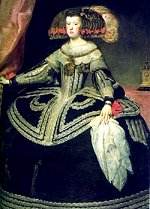
The theatricality of Elvira's first appearance, framed by a doorway with brilliant blue background behind, and dressed in a Spanish court costume (made familiar and memorable through the paintings of Velasquez) speaks volumes about a body being hemmed in by a wire cage. The bold and seductive colours, the luscious fabrics and the variously and beautifully coutured dresses of her (no less wire-caged) attendants create a show meant to focus attention on surface and to divert it from unwelcome analysis. Ernani in common-sense practical garb and through identification, the audience, is meant to counter this display of power through dress. At the end of the opera Elvira emerges as a modern woman, a real person, clothed in a softly flowing robe, urged by her self-sacrificing lover Ernani to go on living (or to start living). The King, and his eagle-helmeted equerry and the king's soldiers all appear in old-fashioned black medieval garb, with breast plates and articulated segments to their leggings - reminiscent of an army of beetles. The 19th century censors would have understood the drift of these undercurrents, especially if they, like us, had seen the Church dignitaries parade in support of the establishment. A captivating and thoughtful presentation of Ernani; not to be missed!
|
 Ernani: Rhys Meirion