
 |
 |
|
 |
||
|
Photo: James Poke Andrew Zolinsky, 1998 winner of San Francisco's International Piano Competition, is giving a thoughtfully constructed series of recitals during the weekend, exploring what he conceived as "Transcendental Piano", juxtaposing traditional and contemporary music that is 'visionary and of great emotional depth'. He is a relaxed communicator with an audience, both verbally and in his playing. He found just the right sound on the Blackheath Bosendorfer for Mozart's Fantasia K.396 (Mozart actually composed only the first 20 bars!) and a different one for his searching performance of Brahms Op 118, six pieces which 'experiment with rhythm' and 'eliminate the first beat of the bar as a strong beat'. These were treated soberly, with careful voicing of chords and delineation of the harmonic movement, sometimes a little slower than one is used to, but these would have been ideal expositions of the music for listeners unfamiliar with them; an excellent corrective to the idiosyncratic and self-indulgent version by the hyped Lang Lang, painfully recalled from the City of London Festival. Late Brahms led naturally to Schoenberg's concise Six little pieces Op.19 and, across the interval, to Rihm's Bagatellen - Klavierstucke 6. Here at Blackheath their spare concentration and small gestures, often single well notes and chords placed amid silent pauses, with occasional brief violent eruptions, made a strong impression, holding the audience rapt. There was the sound of wind in the trees outside, but (as with rain on the roof at Sutton House) this natural sound was not distracting, contrasting with the disruption by mechanical noise interference at Ian Pace's premiere of the Klavierstucke complete at King's College*. To end, a powerful account of Beethoven Op.111, for Solinsky 'the most visionary of all piano works', played from the score and, as was the whole recital, far from the 'automatic piloting'** which can undermine so many performances by pianists who have travelled the world too long with their repertoires. Next morning, at Blackheath's regular Sunday Morning slot, a fascinating sequence from Couperin to Ligeti, with Szymanowski's Tantris the Clown to demonstrate his credentials in more conventional post-Lisztian virtuosity. Of particular interest was a group of two 'ostinato' pieces, Chopin's Berceuse and Peace piece by Bill Evans followed by two of Ligeti's Etudes book 1, given without breaks for applause at Zolinsky's request. The series was to end the same afternoon with American experimentalists as a foil to Copland's great Piano Fantasy. Plenty of material for a forthcoming CD from Metier, worth keeping a watch for its release. * - - Rihm's piano pieces veer from manic activity to stasis - " ultra-dialectical force-fields ", as Pace puts it - but the Great Hall at King's was quite the wrong place to perform them, as the quiet music and the subtleties of internal resonances inside the piano were absorbed into extraneous noise, seemingly from extractor fans close by - in the past there I had wondered about air conditioning being the cause. [To illustrate this difficulty, listen to some quiet extracts from Klavierstücke 6 .] - - ** - - two worrying experiences of hearing famous pianists in mid-career; both seemed affected by the routine of the virtuoso's lifestyle and there was a feeling of playing on auto-pilot? - -
|
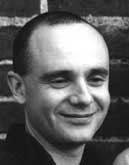 ZOLINSKY at Blackheath Halls