
 |
 |
|
 |
||
|
Haydn,
Beethoven and Schubert After
Helen
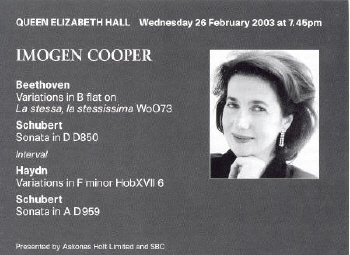
Reid's exemplary recital on Blackheath's Part of Imogen Cooper's Schubert Master Class, which I had been able to attend the previous week, had been enthralling in her detailed exposition of the first movement of the D major sonata D850, attending to every dot and sign on the page, and giving new ideas to an experienced Japanese post graduate student, with whom she swapped Steinways with her pupil for particular passages, because 'no one piano can meet all Schubert's needs'. Yet at the recital some of this seemed to go by the board. Imogen Cooper applied a generalised sound and manner of playing to Haydn, early Beethoven and late Schubert. Too much was smoothed out by controlled yet (to my taste) excessive pedalling, which tended to overlay staccato markings, and by insufficient emphasis for sforzandi and dynamic contrasts; these clearly were decisions she had taken after long study and recording most of Schubert's piano music. It was more like a transcription for Steinway and the QEH than a recreation of these composers relating to their own times. Perhaps my response was idiosyncratic because I have been listening so much to different and older pianos and it was hard to adjust to the sound in a large and full hall? The programme was overloaded, with the second of two of Schubert's largest and longest sonatas taking us to after 10 p.m. Beethoven's neglected Variations Wo073 on a tune from Salieri's Falstaff were athletic but dull, which the Salieri opera is not! Imogen Cooper thinks they are witty, but did not demonstrate that in performance. Beware of the early 'Werke ohne Opuszahl' (works without opus) as they rarely show the composer Beethoven was to become. Haydn's marvellous Variations were softened and romanticised, and the terrifying, indeed almost psychotic, outburst in the slow movement of Schubert's late, great A major sonata D959 went for little. I am not opposed to Steinways for earlier piano music in large halls (q.v. Grigory Sokolov at Lucerne) but like to hope that pianists nowadays will want to have experimented with playing those works on earlier instruments, or modern copies of them, and that this will inform their performances. RECORDINGS
SUGGESTIONS Haydn: Beethoven: Schubert:
Peter Grahame
Woolf Feedback is always appreciated. Please let me know if you have found it rewarding to follow at least some of the links, 'the power of the Internet'? There are also links within some of those links, to beguile you for such time you can spare to explore pianists and pianos - a guided voyage of discovery, all at the click of a mouse. |
 Bösendorfer the
previous evening, this was a disconcerting experience. Imogen
Cooper is a renowned Schubert specialist, and the programme
book highlighted quotes from reviews of 'The Famous Schubert
Recordings', so afterwards there was a queue for the now entrenched
ritual CD signing. We found ourselves at odds with the enthusiasm
of the capacity QEH audience.
Bösendorfer the
previous evening, this was a disconcerting experience. Imogen
Cooper is a renowned Schubert specialist, and the programme
book highlighted quotes from reviews of 'The Famous Schubert
Recordings', so afterwards there was a queue for the now entrenched
ritual CD signing. We found ourselves at odds with the enthusiasm
of the capacity QEH audience.