
 |
 |
|
 |
||
|
Janacek at Wigmore Hall & at Royal Academy of Music
The Cunning Little Vixen, Royal Academy Opera 29 March 2003 A fine feast of Janacek, got off to a fine start with a compelling performance of one the most challenging of Janacek's quirky ensemble pieces with piano, his Concertino. Usually the concertante group of 3 strings and 3 winds looks a little lost on a large platform, so it was good to have them filling the Wigmore Hall platform (it received its British premiere there in 1926, with Leon Goossens playing the oboe, so Bayan Northcott tells us) around Andras Schiff's Steinway. He played with enormous conviction and a huge dynamic range, getting fullest power from this emotionally equivocal work, and too from his solo contributions, the dark Sonata (From the street 1.X.1905) and the bleak In the Mist. A particular pleasure and surprise was the First String Quartet
(The Kreutzer Sonata) given by the vastly experienced Panocha
Quartet, whose members had been together since they were students
together in 1968! From their LPs I had discovered how many Dvorak
string quartets there were, other than the then ubiquitous American
(which during my youth used to be called the latterly politically
incorrect Nigger!). The concert was flawed only by its ordering. Mladi is so precious an old man's evocation of youth, and one that remains ever-fresh, that it was given last, hopefully to send us home with a warm glow of contentment. It was however the weakest performance of the evening, not surprising given as it was by an international group of performers, who might have been brought together for this event. They gave it a good enough run through but without any distinctive interpretative attitude emerging, and their balance leaving us wishing there had been a conductor, or at least a director (Andras Schiff, why not?) to sort it out. Perhaps I was unduly influenced by recent memory of an outstanding
interpretation and performance by the Ensemble
Q at Blackheath, which I hope may be captured on their forthcoming
second CD. If Janacek's Youth at Wigmore Hall was a small disappointment, it linked well with the following night's student presentation of the Cunning Little Vixen by Royal Academy Opera. It is not so very long ago that Janacek was considered a difficult composer for orchestras and audiences. (I remember the BBC Symphony Orchestra struggling with Taras Bulba at rehearsal, and Rafael Kubelik coaching us to pronounce the composer's name correctly). We were lucky to attend the last of R.A.M's four performances, and the second by the second cast of students, in the Royal Academy of Music's presentation of the ever-delightful and deservedly popular Cunning Little Vixen. By Saturday, the student orchestra down in its deep pit was playing confidently and were fully equal to conveying securely Sir Charles MacKerras's unsurpassable vision of this magical work. It rolled back the years to memories of his pioneering studies of Janacek and his supposedly eccentric orchestration scoring (smoothed out in earlier editions). MacKerras's promotion of the operas, one by one, at Sadler's Wells gradually brought this idiosyncratic composer into the UK operatic mainstream, and he went on to record them in Vienna, with the incomparable Elisabeth Soderstrom. The RAM production avoided the 'tweeness' of some others and its budgetary limitations for scenic presentation were turned to advantage, as was the small stage at the comfortable, well-raked Sir Jack Lyons Theatre. It helped to remind us of the opera's origins, serialised in a popular newspaper, strip-cartoon stories by Rudolf Tesnohlídek, with illustrations by Stanislav Lalek.
The slaughtered hens made a costume change to emerge again as a brood of fox cubs (some of them grown with indecent haste to have become at least as large as their mother). A pity that the Royal Academy of Music did not recruit some of their Saturday morning Junior Exhibitioners (my small son was one of those several decades ago) for those not too demanding parts in the last Act. A darker note was brought in with the discontented human characters, especially tenor Edward Lyon as a lugubrious schoolmaster, conveying his isolation with admirable stillness. At the end Rodney Clarke rose to the Forester's musings about nature's renewal, and everyone made their contributions in the cameo parts. But it must not be forgotten that this was primarily an educational project, participation in the large casts being as important as individual excellence. The overall team work was entirely admirable and this was no poor man's Vixen; taken as a whole, it bore comparison with many of the prestigious productions world-wide. The show had benefited crucially from the
subtle direction of famous movement expert, Anna Sweeny,
who had been responsible for the marvellous L'enfant et les Sortileges
at the inaugural production** of the
newly-established Royal Academy Opera in February 2002, and again
helped them to assume far-out roles without any self consciousness
so that we easily suspended disbelief and entered into the spirit
of the enterprise **- - (reviewed for Classical London/Arts Opinion February 2002): Hans Werner Henze: Das Wundertheater; Ravel: L'enfant et les sortilèges Royal Academy Opera & Sinfonia/Dominic Wheeler; Anna Sweeny Director; Michael Holt Designer; Leonard Tucker Lighting Designer. Sir Jack Lyons Theatre. - - This occasion celebrated the opera work of Anna Sweeny with her award as Honorary Member of The Academy. Her particular expertise in stage movement was well displayed in both these these impressive productions, which once again demonstrated that for really inventive and well co-ordinated opera production, the schools and colleges should never be overlooked. Team-work predominated and the singing was uniformly excellent, with too many potential stars of the future to name the soloists individually. - - Ravel's L'enfant et les sortilèges is always a joy, equally for young and old, with its naughty child (Trine Bastrup Moller really not naughty enough) and a marvellously conceived assortment of talking teapots, amorous cats, a fire bursting out of the grate and a menagerie of animals in the garden, all dressed and choreographed with great imagination. Large casts and a full Royal Academy of Music Sinfonia in the capacious pit of the attractive and comfortable Sir Jack Lyons Theatre - credit all round for an evening to savour, giving a splendid launch to Royal Academy Opera. For another take on Collete's scenario 'Ballet pour
ma fille' do see Jiri
Kylian's marvellous Nederlands Dans Theater version on
Arthaus DVD 100 102. (ArtsOpinion) |
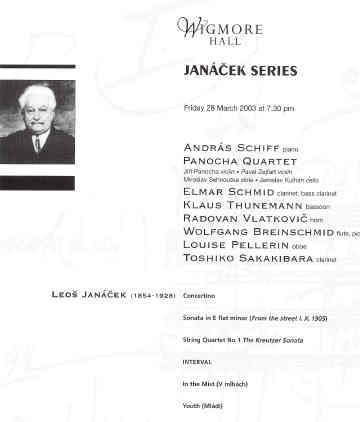 Andras
Schiff, Panocha Quartet and wind players, Wigmore
Hall 28 March 2003
Andras
Schiff, Panocha Quartet and wind players, Wigmore
Hall 28 March 2003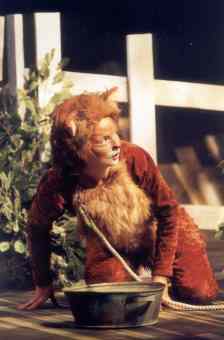 The
students were mostly well fitted out in amusing animal apparel and
in Sarah Tynan* they found a
real star as the feisty and sexy heroine, who fooled everyone and
gleefully destroyed all the beautifully observed hens and their
stupid leader, an unintelligent cock. But to bring a more serious
and reflective tone into the fable, Janacek altered the original
in his own libretto, having our heroine killed, but not before a
romantic courtship with Rebecca Cooper, the handsome fox,
assures the preservation of the cycle of life in this microcosm.
The
students were mostly well fitted out in amusing animal apparel and
in Sarah Tynan* they found a
real star as the feisty and sexy heroine, who fooled everyone and
gleefully destroyed all the beautifully observed hens and their
stupid leader, an unintelligent cock. But to bring a more serious
and reflective tone into the fable, Janacek altered the original
in his own libretto, having our heroine killed, but not before a
romantic courtship with Rebecca Cooper, the handsome fox,
assures the preservation of the cycle of life in this microcosm.