 |
 |
|
 |
||
| National
Youth Orchestra of Great Britain/Yan Pascal Tortelier conductor Barbican Hall 15 April 2003 SIBELIUS Symphony No 5
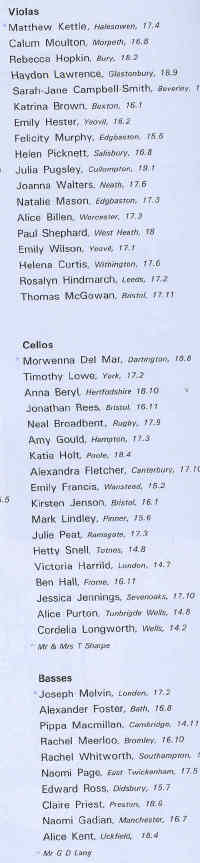
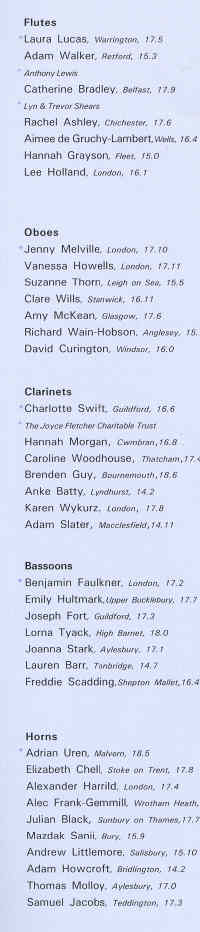
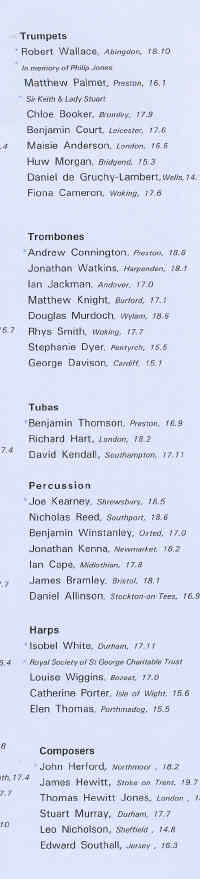
Yan Pascal Tortelier was less convincing with Sibelius 5. It can't be boring, but this performance was bloated and indifferently balanced. Worse was to come with the Manfred Symphony (not one I risk hearing often; Michael Tilson Thomas will be doing it 10 May with the San Francisco Symphony, but I shall not be there). The composer had his doubts and did not include it in the numbered symphonies; Anthony Burton writes a descriptive and (fairly) persuasive programme note, telling us that Tchaikovsky turned against it and that the finale's orgy owes its existence to Berlioz's. It is not to my taste at the best of times, and no way improved by being banged out by a double sized symphony orchestra. The NYO's programming is based on making sure that everyone on the course gets a go (my younger son got a chance to play his trombone in the finale of a Brahms symphony) but there is a danger that the kids may be left with a wrong message, that the best concerts are those given by large symphony orchestras. Is it not time for a little lateral thinking? My suggestion would be to split the orchestra into two of around 80 each, have each one play a different shortish work in the first half of a NYO concert, then give over the second half to a specially commissioned work for double symphony orchestra, ranged either side of the conductor - or else, think about Simon Bainbridge, who composed a magnificent one for the BBC Symphony Orchestra, Fantasia for Double Orchestra (1983) [Continuum, 1993: B000003X09]. I'm sure there are several other composers who would grasp that nettle avidly and might be able to produce something truly memorable, though not necessarily as loud as yesterday's concert? For now, I leave you with an image down the side corresponding
to that on the platform - a complete list of the participants; not
a tidy page, admittedly, but everyone in NYO April 2003 will have
their name on the internet in perpetuity, and that's a part of what
it is all about.
|
 This
was the least satisfactory of the NYO concerts which I have consistently
enjoyed over many years. They always fill The Barbican and success
is ensured by an audience full of proud Mums, Dads and Grans of
the players (I was one such decades ago). And the centre of interest
is that marvellous sight on the platform, a vast orchestra of some
150 and more instrumentalists, doubled and quadrupled without scruples.
It requires enormous skill and experience to manage that and keep
the music itself in the forefront, and in recent times
This
was the least satisfactory of the NYO concerts which I have consistently
enjoyed over many years. They always fill The Barbican and success
is ensured by an audience full of proud Mums, Dads and Grans of
the players (I was one such decades ago). And the centre of interest
is that marvellous sight on the platform, a vast orchestra of some
150 and more instrumentalists, doubled and quadrupled without scruples.
It requires enormous skill and experience to manage that and keep
the music itself in the forefront, and in recent times