 |
 |
|
 |
||
|
Zurich Opera L'Incoronazione di Poppea (concert performance) Royal Festival Hall, London 4 March 2005
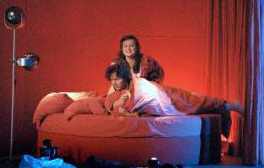
This is how the love scene between Poppea and Nero looks in Zurich! The whole point of this great early opera is the outrageously subversive and amoral libretto and its scope for theatricality. It has now been seen often in UK in a wide variety of imaginative stagings* and Monteverdi's operas are by now best kept out of the concert hall. It is hard to understand why it was chosen for a showcase Zurich Opera concert performance on the sterile, atmosphere-lacking platform of the Royal Festival Hall? The singers, doubling some of the parts, were placed behind the large orchestra. It started well enough with Irene Friedli and Eva Liebau as Virtue and Fortune, and a winningly confident small boy, Tino Canziani, as Love, but the illicit love scenes between Jonas Kaufmann as the appalling Nero and Vesselina Kasarova as the aspiring empress carried little erotic charge. The sur-titles were small and not easy to read, and longeur set in. An expensive exercise, and Zurich Opera would have done far better to have brought to London instead Ariane by Dukas, their recent triumph; that one, with its full symphonic orchestra, would have thrived in concert performance and perhaps prompted some Londoners to seek out its next stage revival in Switzerland? Harnoncourt is always worth hearing and his version of Monteverdi's Il Ritorno d'Ulisse in Patria was a high spot of the 2002 season in Zurich. L'heure espagnole and Les mamelles de Tirésias Guildhall School of Music and Drama 2 March 2005 Guildhall School of Music and Drama 2 March 2005
The Guildhall School's double-bill of short French operas was not one of the college's finest nights. Ravel’s 1911 L'heure espagnole is a slow-moving one-gag comedy, funny when you first see it, and performed stylishly and musically by the second cast in the last of the four performances, by which time the orchestra under Clive Timms sounded confident and idiomatic, as was Anna Stéphany as the sexually frustrated wife, Concepcion. She was well supported by her disappointing lovers, who had to be hidden in the clocks, and she sensibly opted finally for John Llewelyn Evans, as Ramiro, the lusty muleteer. But the misconceived production was seriously hampered by digital updating, and Evans made carrying the flimsy modern clocks around look as easy as it really was; no impression that his strength (=virility) was needed to transport their human contents. Apart from the one running joke, the humour is in the detail of the text, and the lack of surtitles made the hour a long one. Poulenc’s 1947 opera-bouffe setting of Apollinaire’s surreal text was given in period guise and appropriately as an end-of-term school romp. Poulenc's 1947 music is facile and brash, and at first Susanna Andersson was disconcertingly just behind the beat, but ensemble tightened, enough of the text (given in English) came through, and a lot of laughter was duly generated. *The Crowning of Poppea was a notable success in English at ENO, and Trinity College of Music gave L'Incoronazione di Poppea recently (in Italian with surtitles) with equal distinction, using the architecture of a great City of London church for its setting. |