
 |
 |
|
 |
||
|
Prokofiev
and Shostakovich (and Ustvolskaya) Under Stalin Sergey
Prokofiev 5 Poems (Akhmatova) for voice & piano, Op.27 Galina Ustvolskaya Symphonies Nos. 2,3,4 & 5. [TT: 50 mins] MEGADISC MDC 7854 (Purchase from patrick@megadisc.be) This is a difficult report to write, one about two worthy endeavours which were hard to enjoy, and clearly neither was meant to entertain! Vladimir Askenazy is nearing the end of his series with the Philharmonia Orchestra surveying the life and music of Prokofiev and Shostakovich under Stalin. On this occasion he forsook the rostrum and returned to the piano to accompany three fine singers in succession. I wondered why Ashkenazy had the lid on a short stick, boxing in the sound, quite unnecessarily. It proved to be an event of pervasively heavy gloom, lightened only by Elena Prokina's singing of Prokofiev's restrained and lyrical Op.27, settings of 5 Poems by Akhmatova; the Prokofiev of the First Violin Concerto and Visions Fugitives. We were then plunged into darkness with Shostakovich's Op.145, a Suite on poems by Michelangelo Buonarroti for bass, declaimed by Sergei Leiferkus with impressive authority; but they are too unvarying to make for a comfortable concert item. There was more scope for Ashkenazy at the keyboard in Rodion Shchedrin's vocal cycle My Age, My Wild Beast, on words by the doomed poet Osip Mandelstam. A versatile tenor, Mark Tucker, more often associated with early music, stepped in at very short notice (you'd never have guessed!) and gave a confident account which belied the situation. He was assisted by a narrator in a drawing-room chair, Harriet Walter, who read out bits of biographical information (which were also provided in our programmes) from the score, whilst Ashkenazy played lightly at the piano, as if improvising, though he wasn't; an odd example of the strange genre of melodrama of which the Tennyson/Strauss Enoch Arden is perhaps the most celebrated example. My Age, My Wild Beast is a curiosity, not really a viable concert cycle, and was given in the presence of the composer. Shchedrin is deservedly better known for his orchestral Carmen Suite, popular for ballet, and used for a truly remarkable DVD, Mats Ek's Carmen (Arthaus 100 182). All the singing was of high quality and the capacity audience was clearly moved by the occasion. -
- - - - - -
Subsequently
I have written about Ustvolskaya's music extensively, in particular
a comparative
survey of her piano music on CD, studying it at the keyboard
(a lot of it is not too hard) as well as by listening. The piano
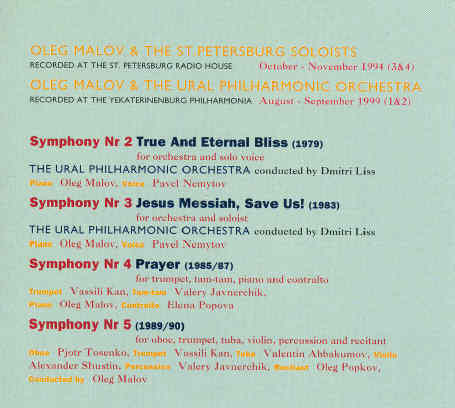
is central to Ustvolskaya's compositions and is played by Igor Malov
in all but one of the four works collected here. There is more variety
in her six piano sonatas than in these so-called symphonies. Each 'symphony' is in a short single movement, proceeded at an unvarying steady tempo, often with relentless percussive thuds. The instrumentation is restricted, and the small groups of instruments are not treated idiomatically. There is nothing ingratiating about Ustvolskaya and she will never be a box office draw. Each of these works is a ritual, with a voice declaiming fragments of text, biblical or short groups of holy invocations, 'murmured complaint or insistent supplication, as opposed to the cosmic indifference of the music' (Franz Lemaire). So, this is not music for entertainment, but it is music that demands to be known and absorbed, even if you feel, as I do, unable to take these separate works more than one at a time, and not too often. These are authentic performances and the recording and documentation are entirely satisfactory. You may think that 50 mins is short measure - but played straight through it will drain you! Peter Grahame Woolf |
 By
coincidence, I had been listening to Galina Ustvolskaya's
music for CD reviewing earlier that same fateful day. In the mid
'90s I encountered Ustvolskaya's uncompromising music and went into
a degree of shock. With its stark tone and unconsoling religious
basis, reflecting the horrors and privations of her life under Stalin,
it made a profound impression . She lives reclusively and has never
travelled to celebrate her late life fame.
By
coincidence, I had been listening to Galina Ustvolskaya's
music for CD reviewing earlier that same fateful day. In the mid
'90s I encountered Ustvolskaya's uncompromising music and went into
a degree of shock. With its stark tone and unconsoling religious
basis, reflecting the horrors and privations of her life under Stalin,
it made a profound impression . She lives reclusively and has never
travelled to celebrate her late life fame.