 |
 |
|
 |
||
|
Die Zauberflöte & Tosca in Kensington Tosca
Holland Park Opera, 20 June 2003 West London is well served for opera. Holland Park Opera has an enterprising summer season, which began with a truly remarkable Fidelio, and is fielding some interesting rarities in the coming months. Their Tosca,
set in Mussolini's Italy, seemed to have been constricted
by a low budget for the staging of James
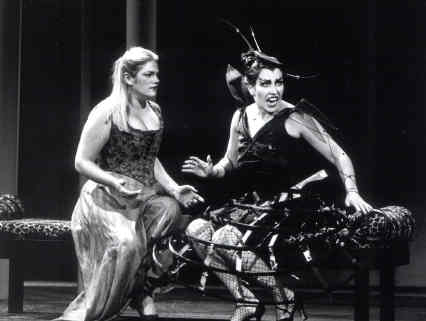
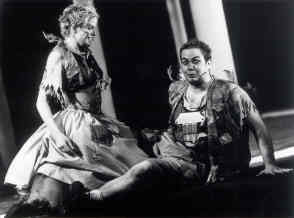
Robert Carson's production. The Royal College offered The Magic Flute (but in the original German and without surtitles - incongruous for a populist singspiel?) in a classy and enjoyable production by Juha Hemánus, notable for fairly simple yet ingenious staging on sets by Ruari Murchison, in alluring but subtle colours, matched by those of the costumes. The animals were small origami creations instead of providing an opportunity for children as in some productions - a bit of a cop out, but there was no troupe of children to call upon for these, or as the Boys. Evocative lighting by Jon Buswell and pleasing costumes by Angela Henry; all in all a good production team. Andrew Kennedy and Sarah–Jane Davies went through stylishly the ordeals that the opera's story and Mozart's taxing music presented them; I should have preferred Andrew Kennedy to have taken more account that the Britten Theatre is small and intimate. The same applies to the orchestra under Michael Rosewell, which played well in a straightforward fashion, but with little period style awareness and often too forthright for my liking and my ears; in short, a lot of it was too loud in the first Act, but things improved in the second. Shannon Chad Foley is a splendid Papageno, partnered charmingly by Cora Burggraaf in colourful costume; a pity that RCM's photos are in B & W. The Three Ladies sang and moved well and were continually watchable in splendid hats and the The Three Boys, Malin Christensson, Hillevi Berg Niska and Elizabeth Ife brought a knowing poise and charm that is hard to achieve with real boys, although their vocal timbre is preferable. Ana James managed her coloratura efficiently as the Queen of Night but seemed to neglect the phrasing leading to the high notes; a similar problem with Sion Goronwy's true bass as Sarastro; his phrasing lapsed oddly in easier passages - nothing that a little more coaching could not quickly rectify. Jonas Duran was outstanding as a most individual Monostatos. I am assured by those who understand it that the German dialogue throughout was impressively articulated with good accents and clear diction - a tribute to the RCM's language coaches, and important for developing the students' international careers, even though I'd have preferred it in English or at least with sur-titles - one knows the drift, but not every word. Peter Grahame Woolf
Pamina (Sarah-Jane Davies) and The
Queen of the Night (Ana
Shannon Chad Foley (Papageno) Cora Burggraaf (Papagena) Zauberflote Photos: Chris Christodoulou
|
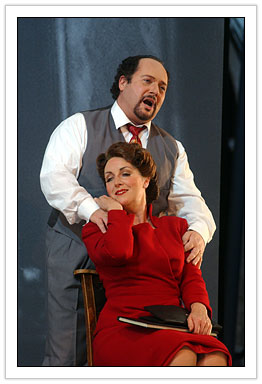 Christine
Bunning's bright red suit hampered her characterisation, which
was vocally decent, but never scaling the heights; she was outshone
by the attractive lyric tenor of Dominic Natoli as Cavaradossi
[pictured].
Christine
Bunning's bright red suit hampered her characterisation, which
was vocally decent, but never scaling the heights; she was outshone
by the attractive lyric tenor of Dominic Natoli as Cavaradossi
[pictured].