
 |
 |
|
 |
||
|
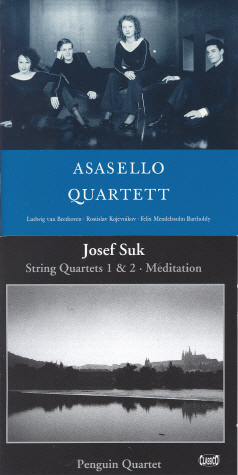
- - Of the two we had heard in the Preliminary Round whom we rated "superlative", the Zemlinsky Quartet went on to win Third Prize and the Audience Prize in the finals and the other (Asasello Quartet) fell by the wayside at the first hurdle. Both of those have CDs for sale which quartet fanciers would do well to acquire. - -
Suk String Quartet No 1,Op. 11 - Meditation on St Vaclav,Op. 35a - String Quartet No 2,Op. 31 (Penguin Quartet (2004) [Classico 700])
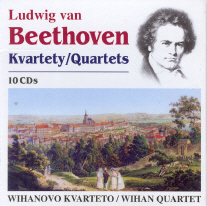
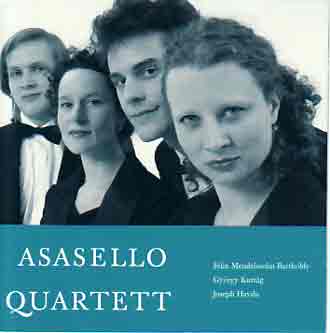
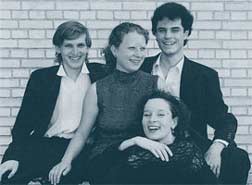
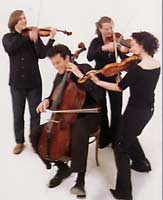
Beethoven Quartets complete (Wihan Quartet, 10 CDs, Lotus LT 0148-2 130) The Asasello and Zemlinsky (formerly Penquin) Quartets were encountered at the 2006 London String Quartet Competition and it is salutary to compare and contrast their experiences in London, and the CDs which were received for review from both (also those from the Wihan Quartet who won in 1991, were present at the Final, and who have just released a boxed set of all the Beethoven Quartets). Penquin Quartet has Suk's two string quartets and his Meditation on an old Czech hymn, 'St Wenceslas', previously recorded by the Suk Quartet (n.l.a). The first quartet is light, the other grief-laden and heavily chromatic. It is good idiomatic playing, a pleasant CD but scarcely one of urgent significance. The Asasello's mixed programme of Beethoven Op 18/6, Mendelssohn Op 12 and Kojevnikov No 3 is altogether different; one of the finest debut CDs I have come across, exceptional in conception and in execution. The programme of "three quartets which all express the tension inherent in the transition from youth to maturity" was chosen with great care, explained in a thoughtful and intelligent liner note (translated in impeccable English!) by the players - "between the innocence of maturing youth and the responsibility of adulthood Beethoven, Mendelssohn and Kojevnikov follow very different paths". They go on to discuss this in socio/political contexts, and it was an inspired decision to feature the response to Schnittke's death by their leader (then eighteen, already an accomplished composer) as the filling in the sandwich. Rostislav Kojevnikov had lived through the fall of the Iron Curtain and moved from Novosibirsk to Basel, where he met his European friends and quartet colleagues, now all based in Cologne. Kojevnikov's 6-movement in memoriam Alfred Schnittke is unashamedly derivative, with quotes and shocks characteristic of his revered master, absolutely appropriate for an 18 yr-old. Mendelssohn's Op 12 is the work in which the young composer of the A Midsummer Night's Dream overture "rediscovered his own authentic style" and it receives here a warm, affectionate performance. The Asasello Quartet's account of Beethoven's Op 18/6 La Malincolia quartet has a freshness which brought back our response to their Haydn and Mozart in the competition; it had the edge over the Wihans account of it in their first Beethoven intégrale (Op 14/1 through to the last quartets + several preludes and fugues) - a fully competitive set at a fair price if you want another, with a few rare extras? As readers of Musical Pointers know, we favour unique discs over single composer selections, and recommend you on no account to fail to acquire the Asasello's CD, which should prove a passport towards concert engagements everywhere, notwithstanding their absence from the London prizewinners roster. October 2007: Haydn, Kurtag & Mendelssohn Quartets The Asasello Quartet's second CD is just to hand in time for their Wigmore Hall debut next month. It is another unique disc which extends the group's autobiography in an intriguing new direction. Exemplifying their mission to take classical music to places where it is rarely to be heard, we have a radio live broadcast of Haydn in Kazan, where you can hear "people changing places and the ringing of a mobile phone to authenticate the reality of the moment"! Microphone placing is amateurish, but the performance does draw you in. The rest are studio accounts of the other great early Mendelssohn quartet, Op. 13, and the oft-recorded miniature Microludes (1977) of Kurtag; he's a year older than me and to my best knowledge still going stong - a little tactless to characterise them as having been written "in his prime" ! He's had another thirty prime creative years... The CD taken as a whole is original and endearing; I hope it will sell well at the Asasello's recitals. Some points about the production; I'm sorry that this time they've gone for a rather drab greenish-blue for the insert booklet, which also affects a little the images of the numerous lively photos squeezed in. And readers know I am allergic to overprinting of small text - legibility is paramount (q.v.our article CD insert booklets). Lastly, they have fallen into a common trap by not having their English vetted by a native English-speaker. Having enjoyed covering their progress through a London competition in which we thought they should have made it through to the finals, we would gladly have organised that for them. Those small caveats apart, a nice Portrait Disc. The Asasellos gave a challenging programme at Wigmore Hall in November 2007; the same Haydn and Kurtag, with Jarrell and the Brahms Piano quintet (Jill Crossland). Fanny & Felix Mendelssohn
String quartets FANNY HENSEL-MENDELSSOHN Quartet in Eb (1834)
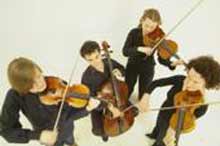
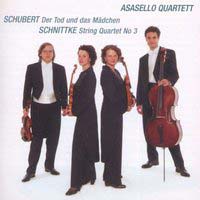
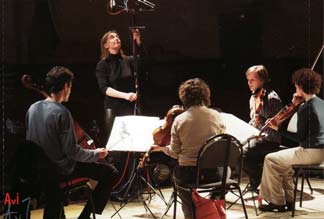
CAvi-music 8553140 [UK distributor Coda] This noted multi-national young string quartet, now based in Cologne, has flourished since we first heard them in 2006. This month, February 2009, they launch their contribution to the Mendelssohn bicentenary, an The playing is idiomatic and the disc will grace anyone's Mendelssohn collection. Peter Grahame Woolf See an e/interview with Barbara Kuster Schubert & Schnittke String Quartets SCHUBERT Der Tod und das Mädchen The Asasello Quartet's latest CD is innovative and will interest audiofiles as well as lovers of chamber music. Their recording producer, Malgorzata Albinska-Frank, has taken a radical approach, and explains how she has virtually eliminated ambience in these two recordings (one live, the other studio) by placing the microphones so close as to "screen off" the room acoustics. To appreciate this to the full, I have listened with earphones which exclude outside sound, taking the music right It works for Schnittke's disturbing essay in polystylism of 1983 (chosen evidently as a sequel to the group's first violinists in memoriam Alfred Schnittke on their first CD). The coupling is an intriguing one which should go well in recital; there was a short vogue for Schnittke's works of this type, but they've gone out of fashion again... But I find that same approach to the sound picture repellent in Schubert's Death and the Maiden quartet, so much so that I can't positively confirm that it is a very good prformance, which I suspect is the case. Most recordings incorporate ambience as an essential of their presentations of classical and romantic music; otherwise, you might as well do masterpiece of the period on synthesisers and electronic instruments instead of fine originals... That reservation apart, the production here is a step forward from that of the Asasello's second compact disc, and our criticisms have been taken on board, including English translations by Stanley Hanks. For next time, how about getting away from those old-fashioned jewel cases; I had to dismantle my copy to scan for you the photo of the recording set-up, partly visible on the back-card... The Asasello Quartet is clearly thriving and I hope their touring will again take in UK; I look forward to their next recording. Peter Grahame Woolf
|
 inside my head !