
 |
 |
|
 |
||
|
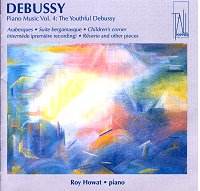
Debussy Piano Music Vol 4
Danse bohémienne (c.1880) TALL POPPIES TP165 [73 mins] I met and talked with Roy Howat at a Royal Academy of Music (London) seminar yesterday. The day before, entirely by chance, I received from Australia his Debussy recordings for review! Tonight, he has a Chabrier event at RAM.
Sampling the (very) complete Debussy piano works (several discoveries in his researches, and the fullest of annotations in the liner notes) I quickly formed the view that this was Debussy as I wanted to hear it, and wished I could make (the easier) pieces sound like that.
The secret is his philosophy, which excludes "aggressiveness" and the combination of sympathetic instruments, venues and audio engineering. I will concentrate on the most recent, but have enjoyed already the Études in Vol.1, less strenuous than some others.
Vol 4 has early works, some of them very familiar to piano pupils young and old. Andras Schiff, beginning a notable series at Wigmore Hall, challenged audiences to his Chopin and his Idols recitals by deploring the commonly held assumption, that " pianos should always be black and made by Steinway". Howat recorded this completion of his integrale at Newcastle Conservatorium, on an Australian piano, Stuart & Sons No 1, presided over by Wayne Stuart himself.
The outcome is pellucid playing of the greatest transparency and sensitivity to the voicing of the music (q.v. Music Web's full appreciation) which, however, doesn't go into the question of 'horses for courses' i.e. the right piano for particular composers.
Another view of Howat's Debussy: Pour le Piano , Estampes , Preludes Bk 1 etc
Roy Howat (piano) Tall Poppies TP164
Is there a right way of playing a composer's music? Roy Howat has a magnificent track record as a French music scholar, and as a stylist in its interpretation (Chabrier as well as Debussy). Pieces of Debussy are still being discovered, not least by Howat himself, and this disc has a musicological highlight, a first recording of Debussy's tribute to his coalman, whose generosity kept him warm in the winter of 1916-7. Howat's playing is intentionally faithful, admirably clear and intellectually transparent in his interpretations.
Ying Chang
If you are seriously interested in Debussy and his piano music, get these CDs (there are four of them) from Tall Poppies and make up your own mind about these opposed responses and tell Musical Pointers?
|
 Debussy Piano Music Vol 3