 |
 |
|
 |
||
|
Chamber & Orchestral Music Verge; Aural Hypothesis; Five Seasons; Tremors Of A Memory Chord Wu Man; Pi-hsien Chen; Callithumpian Consor/tStephen Drury: Palimpset Ensemble/Steven Schick, Shanghai Quartet Naxos: 8572839 After Milou & Brush-Stroke [reviewed below] an equally alluring new CD compilation of music by Lei Liang (b. 1972), with the same intriguing cover illustrator Jon Jin Kim ! Exotic music, whether on traditional western instruments (Verge & Aural Hypothesis) or involving the pi-pa and "grand Chinese orchestra" with specially treated piano which "morphs into various instruments by changing its colour". The production is meticulous, with the composer writing really informative notes and providing precise track timings to focus our attention to particular moments and transitions (as suggested in my review of Miloui below !). Why is that not the norm, instead of still being an extreme rarity? Too many CD notes read as if the annotator hasn't heard the recorded music... Strongly recommended and do take time to try to listen to a fascinating streamed radio interview from WQXR: Lei Liang on Cultural Identity, including perfomances of his very beautiful Lake, Milou, harp concerto and a deeply moving lament Yuen ("injustice") played by the superb Prism Saxophone Quartet; this is an 80 mins radio programme to make BBC Radio 3 listeners of today envious! You will learn, amongst much else, that he was born into a Chinese family of musicologists... Even better, if you Search YouTube, you will find a splendid 2-part video of the premiere of the piano concerto Tremors Of A Memory Chord and be able to enjoy watching the young instrumentalists of the Grand Chinese That really does take Musical Pointers into 2013 ! Peter Grahame Woolf See also lei-liangs-delicate-musical-dramas
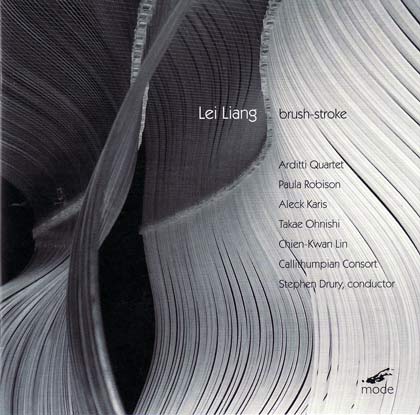
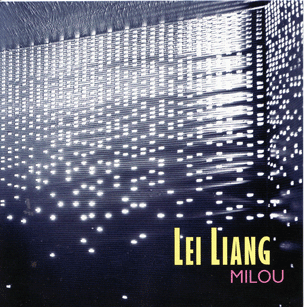
Brush-Stroke, etc Serashi Fragments; Some Empty Thoughts of a Person from Edo; Memories of Xiaoxiang; Trio for Cello, Piano and Percussion; In Praise of Shadows; My Windows; Brush-Stroke Ensembles: Arditti String Quartet; Callithumpian Consort/Stephen Drury with Aleck Karis (piano); Chien-Kwan Lin (saxophone); Takae Ohnishi (harpsichord); Paula Robison (flute) Mode Records MODE 210 This is a splendid compilation which should delight, in part or whole, everyone who comes across it. The pieces are well contrasted and cover many moods and styles, yet with an overall integrated musical personality. He is familiar with most modern developments and is particularly interested in resonances (notably in his piano pieces) derived from a personal technique of One-Note-Polyphony (which smacks of Scelsi's seminal Quattro pezzi chiascuno su una nota sola, and none the worse for that). The flute solo In Praise of Shadows explores shakuhachi techniques and Memories of Xiaoxiang has a tape with fragments of field recordings, including excerpts on the guqin, a lovely traditional instrument to the beauties of which, coincidentally, I had been introduced at a Chinese/Japanese concert last weekend. Fine production and, with an exceptionally beautiful cover image, this disc is recommended not to miss! Peter Grahame Woolf Lei Liang: Milou etc Ascension; Winged Creatures; A Journey into Desire; Yuang; Lake; Concerto for Harp; Milou Manhattan Sinfonietta, the Meridian Arts Ensemble, the Radnofsky Quartet, New England Conservatory Chamber Singers, soloists June Han (harp), Pablo Gómez (guitar), Takae Ohnishi (harpsichord), Jeffrey Milarsky and Tamara Brooks (conductors), John Fonville and Jane Rigler (flutes) New World Records CD 80715-2 ASCAP's highly-acclaimed Audio Portraits feature Lei Liang. A second portrait disc of Lei Lang is equally to be welcomed. A real labour of love, taking from 1997-2011 to complete, this is even more ambitious than Brush Stroke [Mode 210]. A protester at Tiannanmen Square as a teenager who witnessed the bloodshed and had been denied access to Chinese traditional culture under the Cultural Revolution, he has made up for it in his adopted country, USA , studying all aspects of what he'd missed, including copying ancient documents by hand. As a composer he is omnivorous, incorporating with astonishing naturalism elements of avantgarde procedures, indeterminacy and spectral analysis to express "music as a form of ritual". There are seven works, ranging from a piece for two flutes (1999) to a saxophone quartet and a major orchestral work, the Harp Concerto (2008). The presentation is meticulous and the notes by Y U Everett full and helpful; the only point I'd make (not for the first or last time) is that it would have helped even more if sections of longer pieces were marked by new tracks or, at least, e.g. timings of the beginnings of "the second section", and the "third section" of the 14 mins Harp Concerto. This is a disc to play and play again. Peter Grahame Woolf Also received from Mode was Imprints, Veils and Shardsby Joshua Fineberg (b.1969)  mode 208. Although this American composer, extensively associated with IRCAM, is interested in "what is most signficant to a human listener", most of this is recondite stuff, with daunting commentaries. Veils for solo piano has the sustain pedal down throughout for "the real music whose heart is in the underlying continous resonance", but it was not self evident that this takes it further than Beethoven in op 31/2 ? Broken Symmetries for flute, clarinet, horn violin and cello, did hold my attention, though hard to say why; Fineberg says, apropos, that "melodies and clearly defined gestures are easier to remember" and create a "nuanced experience for the listener", but I would need others to help me understand how... Best to sample before purchase. PGW
|
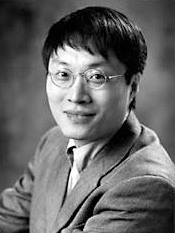 Lei Liang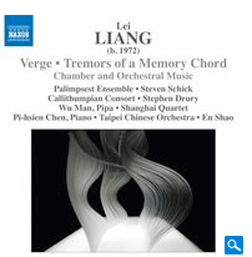
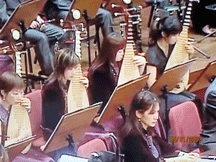 Orchestra and Pi-hsien Chen's indefatigable playing on the keys and
 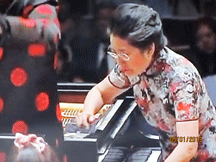 inside the piano!