 |
 |
|
 |
||
|
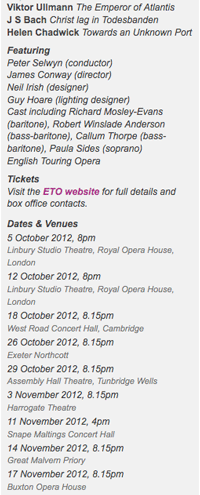
Viktor Ullmann The Emperor of Atlantis Bach Christ lag in Todesbanden (arr. Farrington; in German with English surtitles)
James Conway director
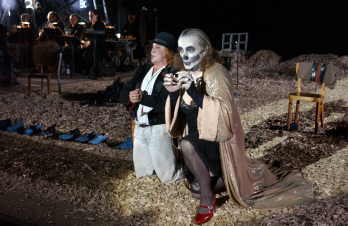
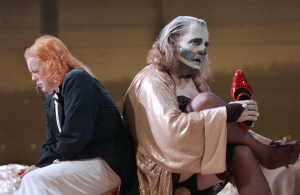
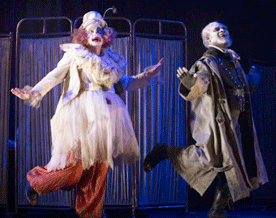
Cast: see below left English Touring Opera is touring a compelling account of Ullmann's chamber opera at the Linbury Theatre, one definitely worth catching somewhere near you. At Covent Garden's Linbury Theatre, seen from the top balcony (far more comfortable than the cramped stalls with restricted legroom !) the acoustics were ideal and the orchestra tended to steal attention from the stage. A stroke of genius in this revival (The Emperor of Atlantis is, sadly, always topical) was the extension of Ullmann's Bach-inspired Chorale epilogue with a poignant staging of Bach’s cantata Christ lag in Todesbanden arranged by Iain Farrington (brilliant regular provider of reduced orcheatral scores for the The singers were introduced to us as confused arrivals with their suitcases at the Terezín concentration camp (see the history of the work's creation in Alexa Woolf's review of the 2004 Lucerne Festival production, below). The whole, played without an interval, makes for a satisfying one-act opera experience and although the text was hard to follow in detail (even with help from someof thewords projected from the stage and on screens at the side). Do see on YouTube survivor Alice Herz Sommer and director James Conway introducing this unique opera, and Terezin where it was conceived. A full, amply illustrated review of this production at Aldeburgh is to be found from The Arts Desk. Click too for TheArtsDesk's critique and ripostes of a production at Arcola Theatre last year. Peter Grahame Woolf Images: Death & Uberall; Death & Harlequin
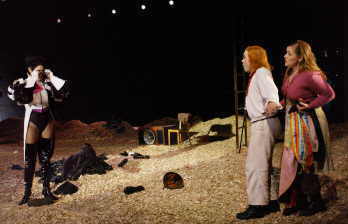
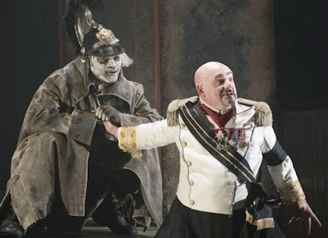
SPIEL IN EINEM AKT VON VIKTOR ULLMANN; LIBRETTO VON PETER KIEN Der Kaiser Urban Malmberg Lucerne Theatre opened its season with a brilliantly staged and thought provoking production of The Emperor of Atlantis. The venue chosen was a temporarily converted floating dock in the industrial part of the lakeside, which you pass when walking to Wagner's villa Triebschen, now a fascinating museum and not to be missed. The new theatre director, Dominique Mentha, in collaboration with the new music director, John Axelrod , have not shied away from an uncomfortable tale (see also our review of their production of Stallerhof). In some ways they have managed to upstage the more traditional offerings of the Music Festival with an emotionally intense and intellectually, as well as visually, reverberating work which deals with a dark episode of European History. The Emperor of Atlantis was composed and rehearsed in Theresienstadt, the 'cultural' concentration camp under Nazi rule. The work never reached performance stage there. Ironically, only the singer of the part of Death survived the camps. The manuscript, however, was preserved having been handed to a friend of Ullman's before his deportation to Auschwitz. It found its way to England but was first produced in Amsterdam in 1975. The Emperor of Atlantis is at one and the same time everywhere, nowhere specific, as well as a reference to Nazi politics and atrocities. It transcends the historical elements bound up with Nazi persecution and ideas of world domination, and reaches beyond towards universal predicaments and truths. 'Overall', the Emperor, could be any unbalanced, power-hungry and destructive dictator; anywhere, anytime. The story is deceptively simple, harking back to old popular 'Everyman' themes with an emperor, his side-kick, a drummer (dressed stunningly as an eroticized, seductive drum majorette), a soldier, a girl, Harlequin and Death taking the stage. 'Overall', the emperor, declares a universal war and a total kill is proclaimed by the drummer. Death, bereft of his/her power to choose to end life, goes on strike. No one dies any more. Public order breaks down and can eventually only be restored through the consensual death of 'Overall'. The staging by Werner Hutterli is brilliantly simple and appropriate. The almost make-shift appearance of rough wood shavings piled into mounds is set on a covered platform surrounded by open water. At times only a curtain divides the stage from the lake, with illuminated boats gliding silently across in the background to add a surreal note to the setting. Excellently acted and sung and played at its final performance under John Axelrod's sharp musical direction, the presentation did not shy away from the uncomfortable implications of this fable. A vivid production which will stay long in the minds of those fortunate enough to be present. Alexa Woolf
|
 Aurora Orchestra).