
 |
 |
|
 |
||
|
Massenet: Cendrillon
Conductor Martin André March 7th and 10th: This is a brief preliminary notice to encourage readers to try to catch one of the remaining performances of this entrancing production of a Massenet rarity, a welcome alternative to the more familiar Rossini and Prokofiev versions. At the interval after the second of the four acts we felt that Cendrillon (1999), a Fairy Tale Opera to a libretto by Henri Cain, was a neglected masterpiece. Ian Rutherford has set it in the time of its composition, with crazes for physical fitness and photography; 'a great time to live for the wealthy; those without depended on dreams and magic...'. The visual flair was striking in the production's inventiveness, enhanced by choreography in which dancers of Millennium Dance 2000 weave into the action, which centres on the widower Pandolphe's quickly regretted marriage to the titled harridan Madame de la Haltiere. I had reservations about the second half, some of those down to Massenet & his librettist, which may partly account for the opera's neglect? In Lucette's poignant monologue, depicting her scary run home, we were distracted by two screens with video commentary to look at plus the subtitles above (those were very useful, but their text and its timing could be improved). I'd have got her father out of his fancy dress bear costume as soon as he got home, better to assert his authority and make his stand against the ghastly family he'd acquired. The Prince's embrace of a plaster cast was a mistake, as was the dinky-toy carriage. The final resolution seemed rushed and perfunctory (as can often be the case with Haydn's last scenes too).
The Sir Jack Lyons Theatre is a tricky auditorium and, especially in the first act, there was a tendency for some of the singers to drown the orchestra, as if to prove they could fill a large opera house; Seung-Wook Seong has a notably beautiful and flexible voice, but needs help in this area. The female lead parts (including the Prince) were all assumed to great satisfaction, the Swedish Cinderella very comfortable in French. The costuming and stage picture were often ravishing - and droll in their inventiveness when required, as in the family drive to the ball.
Massenet and the orchestra took pride of place in our re-appraisal; why, why no CD or DVD yet? Katherine Bond was a lovely Cinderella in gesture and movement as well as vocally, and Ronan Collet a plausible younger widower, with a smooth French baritone quality. We preferred the dreadful trio of women first time, Laura Parfitt (who had been overstretched as the Queen of the Night) hugely successful as Noemie. Amanda Forbes sung her coloratura impressively, even though her opposite was a little more affecting dramatically. Julia Riley had developed her role as the Prince by this, her fourth appearance.
Images:
Christopher Toulmin
|
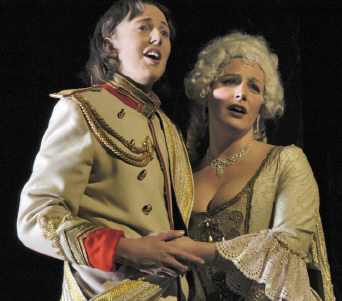
 The logic of magic was introduced to enhance plausibility; the Fairy Godmother contrived that the magic slippers would ensure that Cinderella was unrecognised by the family at the fancy dress ball, so we didn't have to suspend disbelief!
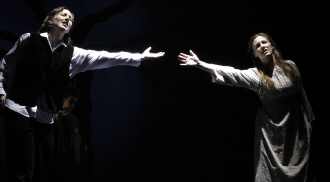 With thirty and more operas behind him including all the familiar favourites (many never produced) Massenet's skills were honed, as is continually evident in Cendrillon's deft orchestration, with many moments of special beauty to savour, the excellent student orchestra moulded affectionately by Martin André.
 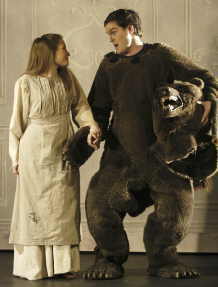 P.S. We enjoyed greatly an opportunity to revisit this delightful opera in order to see the second of the two alternating casts (often missed by the critics).