
 |
 |
|
 |
||
|
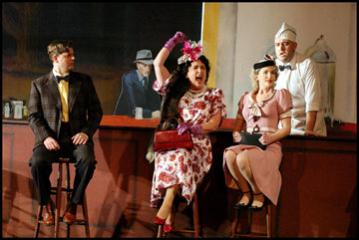
Opera North at Sadlers Wells 9 November 2005 Conductor – James Holmes Director – Tim Albery Choreography – Will Tuckett Set Designer – Antony McDonald Costume Designer – Emma Ryott Lighting Designer – Adam Silverman
Molly Grant – Christianne Tisdale Venus – Karen Coker Rodney Hatch – Loren Geeting Gloria Kramer – Jessica Walker Mrs Kramer – Carole Wilson Taxi Black / Dr Rook – Eric Roberts Stanley – Jeffrey Lloyd-Roberts
Pre-Performance talk By Garrick Forbes
1943 is generally reckoned to be the start of the golden era of Broadway musicals. Three shows opened that year that were to have record breaking runs: Oklahoma , Carmen Jones and One Touch of Venus . Whilst the popularity of the first two has never waned somehow Venus faded into undeserved oblivion, and Opera North's 2004 production is it's first European staging.
1943 was also the year in which Kurt Weill was granted US citizenship, and Venus , (though loosely based on an English Victorian novel) with a book and lyrics by S J Perelman and Ogden Nash is very much an all-american show with a cast of characters that might have walked straight out of Damon Runyan. Millionaire Whitelaw Savory attended by a retinue including his Secretary and a Private Eye, is an art collector. His newly acquired statue, the Anatolian Venus, suddenly comes to life and sets off in amorous pursuit of a humble barber named Rodney. Venus does not hesitate to use her supernatural powers to thwart Rodney's fiancée Gloria Kramer and her mother, and their escapades take them a through a rapid succession of scene changes, ranging from a Society Ball to jail.
The music is equally varied. I'm a Stranger Here Myself was the hit song of the piece, though some connoisseurs regard Speak Low as the better tune. There is a splendid, but perhaps no longer politically correct, barbers' quartet The Trouble with Women (taken from Happy End ), and the ensemble piece The Ballad of Dr Crippen harks back to Weill's Berlin style.
Opera North have a strong record with this type of work, and this production is one of their finest. Antony McDonald's sets take up the art collector theme of the opening scene and his backdrops mirror well known artworks of the day - Hopper, O'Keefe, Warhol, Herge (the jail becomes an image from one of his TinTin cartoon strips) - these are a joy in themselves, and Emma Ryott's colourful costumes are completely evocative of the period. Tim Albery's direction is inventive and sure-footed throughout, and the dance sequences (choreographed by Will Tuckett) lively.
At Sadlers Wells the orchestra played exuberantly for James Holmes and the cast universally sang and acted their parts with gusto. It should have been a wonderful evening, but too much of Ogden Nash's acerbic wordplay was lost* in an overlay of thick mock Bronx accents, and I noticed that quite a few seats were left empty after the interval.
The performance had been prefaced by an excellent talk by Garrick Forbes, who is a member of the ON chorus. He gave an interesting account of Weill's musical training and the reasons for his move to America before providing sidelights on the plot and passing round copies of the sketches for the sets and costumes. He also revealed that Opera North have an even lesser known Weill piece in their programme for next year Der Kuhhandel . As far as I can ascertain, the original version of this work remains unperformed, although Weill produced an adaptation for the London stage A Kingdom for a Cow which was performed in1935. I look forward to seeing what Opera North make of it.
*Nash clearly knew the problem and wrote a poem about it entitled The Strange Case of the Renegade Lyric Writer :
Photo credit – Stephen Vaughan |
 Weill – One Touch of Venus