
 |
 |
|
 |
||
|
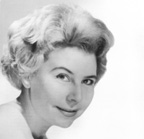
Christa Ludwig Master Classes at Wigmore Hall 12 to 15 February 2003 The Wigmore Hall is presently on a high, with full houses for many evening and lunchtime concerts, and also for daytime educational events, which attract less notice than they deserve.
Attending two of the classes, one noted improvement in the already experienced singers selected for this public exposure, and several themes recurring for attention. Christa Ludwig wished there had not been such a preponderance of sad songs, but that is in the nature of the repertoire for baritones (five out of seven participants). It was necessary to convey the deep pessimism of Strauss's Der Nacht, 'a terrible song', with night extinguishing all colour, and similarly to create the mood of Schubert's Auf der Donau, which predicted the extinction of all man's works and man himself (which she linked to the anti-war rally in Hyde Park that day). Often tempi were judged too slow, stasis likely to put the audience to sleep must be avoided at all costs. Several times she insisted that slow tempi should be two slow beats in the bar, not four. On the other hand, a little movement forwards was often needed, and the pianist had to 'lay a carpet' for the singer. They were helped to analyse the composers' precise intentions and to express a range of miserable thoughts, some of the singers flexible enough to take points on board quickly, others less so. The right rubato was perhaps the hardest to get across for some pairs, with a feeling that neither singer nor pianist was responding to the other, leading or following. Occasionally Christa Ludwig was inclined to conduct for a few bars, which set me pondering why it is that convention (and preservation of dignity) precludes conducting less experienced duos and smaller chamber groups? Sometimes one feels that guidance might sort out desirable tempo fluctuations and balance problems more easily than vocal exhortation, and lift a performance to a higher level? Widerschein (Schlegel/Schubert) was new to Christa Ludwig; she took to this song 'It is good - not everything by Schubert is good' and debated alternative interpretations of the poet/singer's mood, whilst awaiting his beloved who is late for their meeting'. She imposed her own concept by way of experiment, but left the ultimate decision to Christian Immler - 'my lieder singer' - clearly her favourite participant. who was scheduled to take part in a PLG Jenny Tourel 30th Anniversary concert at South Bank Centre the following afternoon. Subtleties of German pronunciation figured often, as did her emphasis on making words intelligible (not always possible at Wigmore Hall) and supporting meaning with vocal colouration and facial expression. More than once she urged more attention to the sound and meanings of the words, e.g. 'they sing beautifully but don't 'speak' the words - it's not enough' - 'You have to paint the picture with the words'. Repertoire attracted stricture; an English soprano was thrown by being told that her voice was not suitable for Wagner and that Ms Ludwig wished she had presented Mozart. By the last morning, however, rapport between them was good, and she acquitted herself well in Berg, confidence restored showing in improved vocal quality. A Swedish tenor chose a 'terrible Italian canzonetta - do we have to do it?' He switched painlessly to Schubert's Der Schiffer and all went well. An endearing mezzo, who had sung Mahler's Rheinlegendschen beautifully, and then was helped to inject every phrase with meaning, surprised Ms Ludwig by choosing Wolf's Abscheid. This was declared a man's song, because ladies don't kick critics downstairs! By the end everyone was convinced that Abscheid could be tackled by a modern young woman, and after the exaggeratedly over-the-top schmaltzy conclusion Christa Ludwig encouraged, teacher and pupil waltzed round the stage together during the piano postlude. Afterwards, all the participants returned to the stage for an informal question and answer session about Christa Ludwig's operatic career, with anecdotes and general advice for young singers at the threshold of their careers. Reassuringly, she told how she lost her voice 'screaming for Solti' as Kundry (a bleeding vocal chord) but, after a long break from singing, she recovered to continue for another twenty years! She stressed that the recital platform is not an easy option for elderly opera singers; 'impossible to drop into lieder', one of the most demanding of all musical genres. The large audiences were enthralled and rapt, learning more about these inexhaustible lieder than would be picked up from hearing them in recital or at home on CD. For young musicians, the best Master Classes are those, of which these were a perfect exemplar, in which the teacher brings a wealth of experience and devotes it entirely to the work in hand, concentrating upon the pupils, not the eavesdropping audience. For young artists to benefit to best advantage flexibility is axiomatic. They should not present fixed interpretations (which are likely, to their chagrin, to be quickly demolished), but instead should prepare themselves by trying every phrase and passage quicker, slower, louder and softer, and think of ways to colour the voice to express words more intensely for the listener. Christa Ludwig distinguished between 'somebody singing lieder' and 'a lieder singer'. For those singers with the gift, teaching after retirement offers a satisfying new career for all concerned. Peter Grahame Woolf For an appraisal of the individual singers on the first morning of Christa Ludwig's course, see http://www.musicweb.uk.net//SandH/2003/Feb03/masterclass.htm
|
 Deputising
at short notice for Dietrich Fischer-Dieskau, the great
Deputising
at short notice for Dietrich Fischer-Dieskau, the great