
 |
 |
|
 |
||
|
Strauss Elektra
Conductor: Semyon Bychkov Elektra: Lisa Gasteen Maids: Frances McCafferty, Ekaterina Gubanova, Gillian
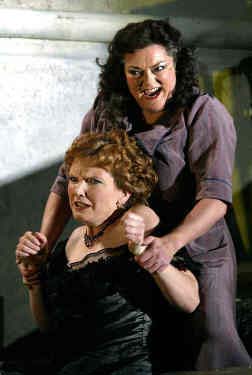
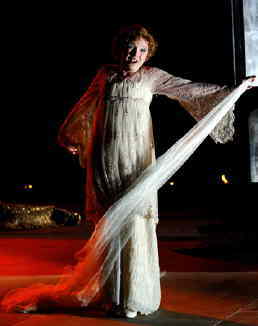
Knight, Gweneth-Ann Jeffers, Rebecca Nash This new production for The Royal Opera is by a new director there, Charles Edwards, with an Elektra making her debut in the role and a substitute conductor replacing Christoph von Dohnányi. Lisa Gasteen was unexpectedly kempt after the build-up to her appearance by the excellent group of servants, well characterised and even individualised, their words (helpfully sur-titled in English) coming up to the amphitheatre clear and true above Semyon Bychkov's considerate conducting.Gasteen was generally adequate, and improved after a start with some vocal difficulty, a gear change for some of the high notes which were uncomfortable for her and for us, sustaining her (vocally) killing role well. Felicity Palmer as Klytemnestra emoted guilty longing for respite from her dreams which could only come with death. Anne Schwanewilms was impressive and brought the only charm into the evening as Chrysothemis, Elektra's sensible sister and reluctant accomplice who just wants to get on with her life. John Tomlinson was magnificent as Orestes, I don't remember another to compare. Ideal seating, with sur-titles at eye level and the
orchestra, in its pit, laid out below us in full view, contributed
to make the score sound as well as ever experienced before - though
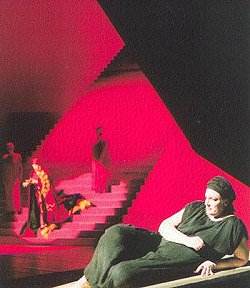
'now' is bound to take primacy Charles Edwards' sets, and indeed the whole stage picture, impressed less. The action centred around a revolving door, which was finally left isolated all on its own, presumably to suggest the unending ritual of revenge and counter revenge which was the way of Greek myth and is of today's world. Whilst the sound of this Covent Garden Elektra, and especially of its orchestral dressing, reverberated overnight and will remain a precious memory, for overall satisfaction we think back gratefully to Herbert Wernicke's inspired, red-drenched staging at Munich, the commanding intensity of Gabriele Schnaut as Elektra and the tortured performance of Jane Henschel, as a grotesque and grimacing Klytämnestra. Peter Grahame Woolf Lisa Gasteen (Elektra)
with Felicity Palmer (Klytemnestra) PHOTOS: CLIVE BARDA Revival of Charles Edwards production, 2008: Royal Opera House, Covent Garden, London November 2008 Conductor: Mark Elder Elektra: Susan Bullock Five years or so on, with the set looking a little shabbier, and Charles Edwards’ direction equally static, but this opera always presents a challenge for its audience. It’s Strauss’s mastery of music that weaves the three central women, each with their own personal neurosis, into a credible plot, and ROH have assembled a cast with considerable experience in this opera. Susan Bullock has sung the title role to wide acclaim, but London audiences have had a long wait to see her interpretation. It’s the strength of her voice and her complete control that is fundamental to the portrayal, allowing her to take risks with her colouring as she summons up for us a woman who has been stretched to her very limits. Jane Henschel has come as close to making Klytemnestra her unquestioned territory, her full earthy voice and larger than life stage presence conjuring up a vision of terrifying dementia. Beside these two, Chrysothemis appears deceptively normal, with Anne Schwanewilms’ silvery tones emphasising her calm and vulnerability. Ms Schwanewilms is close to be my ideal Strauss soprano, as ably demonstrated in her glorious anthology of his songs on the Hyperion label www.musicalpointers.co.uk/reviews/cddvd/hyperionstrauss2.html CDA 67588. A revival of musical stature. Serena Fenwick Elektra,
Aida & Freichutz; Munich
Opera, May 2000 (AW) This
production achieved a unity of high intensity between the musical
and the visual aspects of the drama. It released the emotions and
the psychological depths inherent in the story of Elektra, seizing
our attention and ensuring our involvement from the very first
|
 over 'then'. Bychkov instilled confidence,
with tone quality and balance which made the Covent Garden Orchestra
sound like the living embodiment of Richard Strauss's vision, not
infrequently drawing attention from the singers, especially in some
of the descriptive passages reflecting the near psychotic mental
states on stage.
over 'then'. Bychkov instilled confidence,
with tone quality and balance which made the Covent Garden Orchestra
sound like the living embodiment of Richard Strauss's vision, not
infrequently drawing attention from the singers, especially in some
of the descriptive passages reflecting the near psychotic mental
states on stage.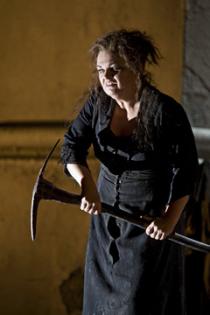
 moments.
A gigantic black wall, nearly full stage height and width, just
slightly tilted, closed off most of the stage and brought the action
up-front close to the audience.From underneath this oppressive wall
the chorus of women just managed to crawl out. Elektra sang sprawled
and facing us on a forward tilting platform and the women conveyed
a picture of abject exclusion and doom, singing crouched on all
fours.
moments.
A gigantic black wall, nearly full stage height and width, just
slightly tilted, closed off most of the stage and brought the action
up-front close to the audience.From underneath this oppressive wall
the chorus of women just managed to crawl out. Elektra sang sprawled
and facing us on a forward tilting platform and the women conveyed
a picture of abject exclusion and doom, singing crouched on all
fours.