 |
 |
|
 |
||
|
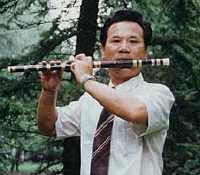
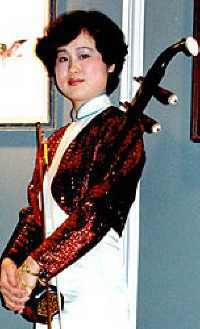
Erhu & Dizi from China; Santoors from India In association with educational events at the School of Asian Studies (SOAS) and the Royal Academy of Music, The Asian Music Society promoted a delightful concert at Purcell Room which gave perfect opportunities to experience the subtleties and varied expression that expert players can produce from the simple six-holed bamboo flute (dizi) and two-stringed erhu (the bow-string between the two sounding strings) Ning Baosheng is a famous dizi soloist from Beijing, and he played on the piercing small flute and several mellow lower examples, one producing a fascinating nasal quality - apparently related to an extra hole 'covered by a thin membrane which acts as a mirliton to give the instrument its wavering and poignant sound' - Mr Baosheng has no English, so it was hard to get a full explanation from him afterwards. Whatever, the dizi in expert hands has all the colour of the Indian and Japanese flutes, displayed in this programme in which he also demonstrated the hulusi, with its double-reed, gourd and drone pipes.
Expertly recorded at SOAS with just the right ambience and reverberation, it all sounds as captivating as were the musicians live at the Purcell Room, presented there (mercifully) without any of the nearly unavoidable amplification which seems to dog presentation of 'world music'; instead creating an atmosphere of intimacy and drawing the audience in to savour sounds of utmost delicacy.
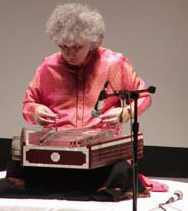
For once direct comparison was possible on the same day. Li Ming's yangqin was clear, bright and characterful in the afternoon; the two hammered dulcimers (santoors) of Sharma father and son in the evening were falsified by arguably unnecessary, and certainly excessive, amplification, with Shivkumar's inexplicable request for the volume level to be increased; and then they were nearly overwhelmed by tabla fortissimo. Is that really what Indian classical music is about? Clearly, it is how London's predominantly Indian audience likes it. Note: Searching amongst my previous reviews, I find a similar reaction in 1999 to hearing Pandit Shivkumar Sharma and his son in concert: Pandit Shiv Kumar Sharma plays the santoor, a simple folk instrument of the hammer dulcimer family, which was previously thought uncouth and unsuitable for serious music. He elevated its standing single-handed, and could be compared with the achievements of Casals for the cello, Tertis the viola, or Segovia the guitar. Make no doubt, these two Indians [Sharma & flautist
Chaurasia]
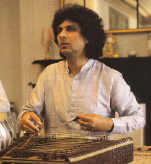
are musicians of like calibre. To hear the santoor played by Shivkumar Sharma some twenty years ago (pictured R), listen to him playing two ragas on Nimbus NI 5110. T hat company, responsible for so many wonderful early CDs of Asiatic music, was reborn Phoenix-like after its untimely demise. There the sound of both santoor and tabla is markedly less percussive, which I can only attribute to the settings at Purcell Room having favoured 'brilliance'?
|
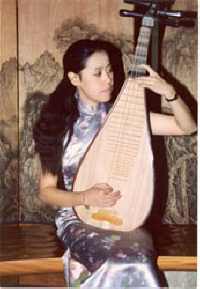 self-effacing on pipa.