
 |
 |
|
 |
||
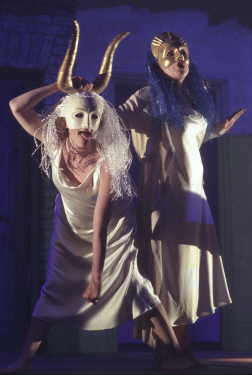
Birtwistle The Io Passion Woman 1 – Teresa Banham (actor) Quatour Diotima Stephen Langridge – director
The Io Passion's economical requirements (4 singers and 2 actors, five musicians and a single set) may ensure a long international performance life for Birtwistle's new chamber opera. It is many-layered, to which we have come accustomed with this composer. In an uncommonly rewarding pre-performance discussion, Harrison Birtwistle's production team joined him to explain the unique development of the piece, a 3 to 4 year genesis which began with a simple drawing of a "stage space" during a tea break during the production of Gawain. That led to exploratory workshops at the National Theatre, with actors exploring the proposed space (no singers, text or music yet). Birtwistle had become disenchanted with the constraints of setting words to make an opera. He wanted form to predominate over content, with emphasis on detail instead of the broad brush of grand opera. To make it a truly chamber work, he opted for the reduced palette of a clarinet quintet, instead of exotic instrumentation which would draw attention to itself, and its novelty pall, "colour implied, like black and white". There were exercises around germinating ideas; an archetypical Man and a Woman outside and inside, communicating only by letter; the Woman reading and dreaming, pouring and drinking a cup of tea, putting on lipstick to go out - form anticipating content. The librettist Stephen Plaice was brought in to provide words 'when singing became necessary' - not for the beginning, which was enacted in dumb show. Towards the premiere additional words were required and Plaice texted them from Berlin on his mobile! Two pairs of singers were needed to flesh out the action and incorporate the Zeus/Io myth in the Woman's dream.* Uncertainties and ambiguities were to stimulate the audience's imagination - Birtwistle said he (and we) should no more want to know exactly what had happened between the couple than to know what actually happened in E M Forster's Malabar caves. Repetition in seven Fits allowed for more information in each repeat; Birtwistle emphasised that although the seven fits might suggest seven days of a week, it was always the same cup of tea, the same letter, the same Man and Woman even when they were triplicated on stage. Towards the end there could be a breakdown of the built-in limitations of the divided set, the imaginary wall omitted when the Io myth took over. The music for basset clarinet** and string quartet was through composed, existing "in its own orbit". Far from coming across as a reduced palette, I found its instrumental music some of Birtwistle's most beautiful and satisfying, constantly alluring and engaging (seated close to the group, the words from the stage were often covered). I wondered how it might go given independently, as a 95 minute single movement clarinet quintet - possibly slightly pruned for concert performance? Certainly less of an ordeal than one of Feldman's gargantuan constructions. A second viewing and listening to this immaculate realisation of Birtwistle's enigmatic vision, sold out at the end of its short run, confirmed admiration for the achievement, all the elements slotting into place like a perfectly oiled machine. Even after having studied the libretto, elegantly printed in double-page spreads (Boosey&Hawkes 13869), some of Stephen Plaice's ingenious text was inevitably lost. Woman 3's spoken exposition of the Io myth was delivered too quietly (q.v. Katalin Károlyi's failure to get across hers for John Woolrich) and it is always hard for sopranos to make words comprehensible in their higher reaches. Cataclysmic emotions were treated in a detached, formal manner, with perfect mirroring inside and outside to left and right of an invisible central wall (amusingly, my 'restricted view' seat had a pillar coinciding precisely with that invisible wall with its invisible mirror!). The actors repeated exactly the detail of every seemingly trivial but portentous routine and the singers were versatile in their role changing; Claire Booth and Amy Freston (pictured) especially memorable. The next opportunity to see The Io Passion will be at Bregenz on July 25. **- - Alan Hacker OBE's interests range from authentic performances of early music to contemporary works. He restored Mozart's Clarinet Concerto and Quintet playing them on an instrument modelled on Stadler's extended basset clarinet for whom Mozart originally wrote them. - - |