 |
 |
|
 |
||
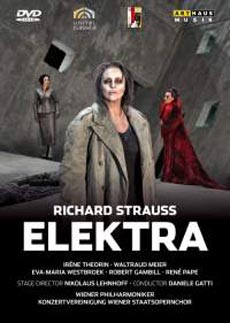
| Strauss Elektra from Salzburg and Zurich Elektra from The Grosses Festspielhaus, Salzburg Festival, 2010 Arthaus DVD 101559 [TT: 109 mins] This DVD of a renowned production seems not to have been filmed live? Or did they just cut the curtain calls and any audience sound; the elaborate camera work could have been disturbing in the opera house. The protagonists are peerless, with voices never showing the strain of their long parts. Lenhoff's direction is satisfyingly detailed in its responses to the text and music; they are ideally transferred out of the opera house for disturbing domestic viewing. The cameras wander around all the corners of Raymond Bauer's terrifying, claustrophobic set and follow the dysfunctional family members and their expressions with stunning close-up views, which never provoke the regrets common with opera. This Elektra was seen for review soon after acquiring a new large screen TV set, which enhances the pleasure in DVDs from newest Bluray to old ones. The sound, difficult to balance in the theatre (see "Elektra batters ear-drums at Salzburg" - the dying screams of Aegisthus were swamped so completely that the only indication of his off-scene demise were the German and English surtitles - sorely needed as diction was generally poor © 2011 AFP) was well managed for the new DVD and I venture to think that the experience overall will have been better for home viewers. Peter Grahame Woolf
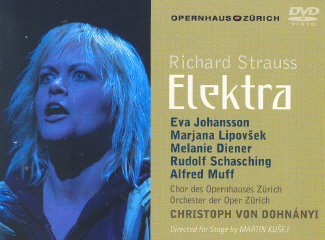
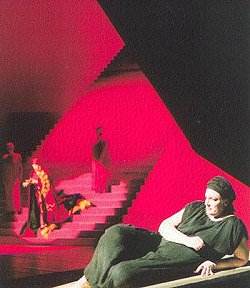
This revival of Martin Kuc's 2003 Zurich production of Elektra has the three female protagonists strongly cast, their characterisations brought into our living rooms in close up filming which catches every shade of facial expression. The production jettisons pseudo-archaic staging of the classical revenge myth in favour of a surreal modern times setting. Rolf Glittenberg's stage is surrounded with gleaming white doors as for a padded cell. No mud, no blood; just a lumpy grey ground covered with a patchwork of mats revealing cracks through which one could imagine hell breaking forth; an incongruous nightmare environment. Awkward physical movement through this space enhances the sense of the psychological unease of the protagonists, and helps to draw us into this unsettling drama. The numerous maids are individuated in the first scene, and subtitles keep us throughout much closer to Hofmannsthal's dense libretto than is usually possible in the opera house (even though the English translation is poor at times). The chorus of servants rush around in "a meaningless permanent orgy". They becomes a major presence throughout the unbroken single act opera, running hither and thither in futile activities, sometimes dressed in formal rig, often all but naked - the maids "tarts in suspender belts and nail varnish" - the men with axes in later stages of the drama, a nightmare scenario. Chrysothemis stresses how the sisters are imprisoned from life 'outside' their dysfunctional and menacing 'family home'. Her longing for a normal woman's life, including child rearing, is counterpointed by the outsider Elektra's single minded focus on her goal. Eva Johansson dresses down to what the TDK commentator describes as "a young punk" - a bit too tidy and clean for a UK punk girl, but the environment is immaculate as it is forbidding, as in a dream. However you interpret all the "psychological and existential truths" on display, Kušej's way is an acceptable and engrossing change from the more usual approach to play ancient Greek myth in an undefined distant past. We are brought into as intimate a relationship to the teasing Elektra and her terror stricken guilty mother, the great Marjana Lipovsek, as they are to each other; riveting singing acting. Johanssohn rises vocally to the demands of the final scenes beyond what one had anticipated when first meeting her, and the climaxes are overwhelming. Underpinning it all is as powerful, and powerfully recorded, an account of the score from Dohnányi and the Zurich orchestra as you could hope for; it must have been devastating in the small, intimate opera house there. At Munich the stage for Elektra was suffused in red, with an immense red door, through which Jane Henschel appeared to descend onto on a bare stage, a grotesque and grimacing Klytämnestra in an enormous, heavy red cloak "like an emblem of the fearful inheritance of guilt assumed and revenge taken up and passed on" (Alexa Woolf). Alexa and Peter Grahame Woolf |