 |
 |
|
 |
||
|
Edward Rushton: Harley
Lili: Irène Friedli
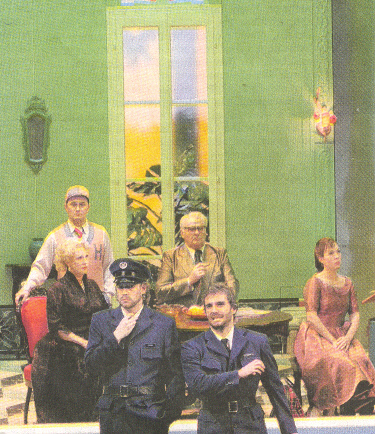
We are well used to statues coming to life on stage; Pirandello has six of his characters upstaging their author in search of their identities; Offenbach and Sullivan have made portraits come out of their frames to sing. The new opera by the still young British born and trained composer Edward Rushton (b.1972) had a forty minute pre-première introduction, with a warning that it would demand a second viewing to properly grasp the ramifications of Rushton's Swiss wife Dagni Gioulami's tale about a family who found themselves trapped inside their own portrait Industrialist's Family in the Green Salon (1951).
In the opera the parents and children of a discontented industrialist are still alive, continuing their quarrelsome lives whilst the art gallery in which they are the chief exhibit is closed; they are aspiring towards change fifty years on. A nice conceit, brilliantly realised in Grischa Asagaroff's elaborate staging for Zurich Opera.
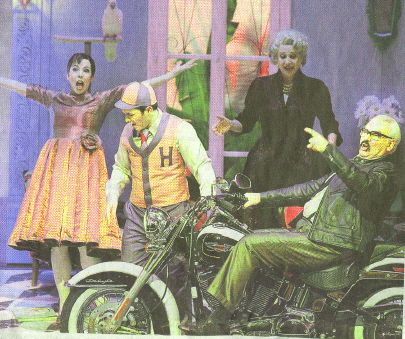
The protagonist is daughter Lili, a manqué artist, who propositions a new gallery attendant Hector to rescue her (he, at the same time, is being pestered by his own daughter to let her go off round the world on her motor bike). He is slow to grasp what the audience can see happening, making for longuers in the first Act. Eventually Hector cottons on and is persuaded to remake the picture, freeing Lili by painting her out, and pleasing her placatory mother by exchanging autumn for spring and the green wallpaper of the salon, which she is fed up with, for blue. Right at the end we learn that for the emotionally disturbed pater familias money-making had not been enough. "Harley" brings salvation and freedom from his bad temper; Harley Davidson the motor bike, not Harley the Street (of London's medics)!
This tale is punctuated by cameo scenes caricaturing 'real life' attitudes to art and art galleries. Visitors, some with intellectual pretensions, pass through the gallery in pairs - in this production by a versatile duo, Stephania Kaluza and Christiana Kohl, who take all the parts.
During the first act we were impressed by the composer's sure touch, with light, inventive orchestration that allowed the voices to be heard easily and a special touch with percussion and onomatopoeic sound. Rushton's idiom was audience-friendly, eclectic mild modernist, sometimes allusive, never too facile. I wondered however if writing for a major opera house had encouraged him to compromise (as with Ades's Midsummer Night's Dream ). But the second act brought scenes that linked with the individual sound world of this fastidious and original, very promising young opera composer we had come to notice in his shorter stage works seen in London, The Man with the Carnation and Birds, Barks & Bones .
Was Harley really ready for high profile presentation? By the end of this, Rushton's first full length opera, we felt that a shorter one was wanting to escape the frame. After the over-long first act some of the audience seemed so incurious as to how the situation set up for them would be resolved that they did not return after the interval; two couples had departed to leave our box to ourselves!
The delays before Hector accepts what is happening could only benefit from substantial cutting. A collective pantomime dream sequence to begin the second act, enacted by cartoon like figures in fluorescent clothing, felt redundant and certainly needs re-thinking. And some of the cameos outside the picture frame were unfunny as well as failing to advance the story; a lesbian 'professor' lecturing a 'student' companion about inferred sexuality in the family portrait and groping her was frankly inept and not at all titillating. The piece needs, above all, editing and shortening.
The costly production by a team led by Grischa Asagaroff did Rushton and his wife proud. All the roles were well taken and the orchestra was secure and perfectly balanced with the action on stage under the direction of the English conductor, Nicholas Cleobury.
The stage picture was always good to look at, with expert lighting contributing a great deal to the illusion that we were being drawn into the inner lives of these portrayed characters, who had to maintain immobility for long stretches. Most notable was Iréne Friedli, who had the best part as Lili, and who finally had 'arrived' with a picture Nightmare in the Green Salon (1962) in the Tate Gallery - the chronology is confused and irreconcilable with Rushton's opera supposedly set "today", as confirmed by the costumes outside the green and blue pictures.
Baritone Gabriel Bermúdez was good as the bemused and ever obliging Hector, who gives the schoolboy Gustavino a parrot who learns to say "Art is Shit", paints out Lili to free her from the picture, and it was a coup de théatre to have her father ride into the new picture, Family in the Blue Salon , on a gleaming Harley-Davidson bike.
See also reviews of Rushton in London
|