 |
 |
|
 |
||
|
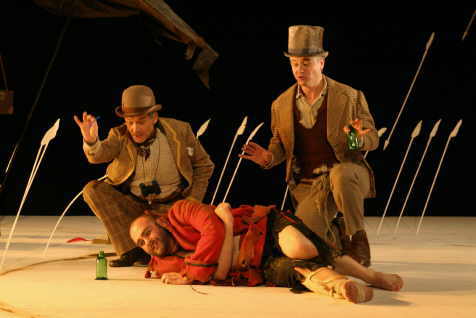
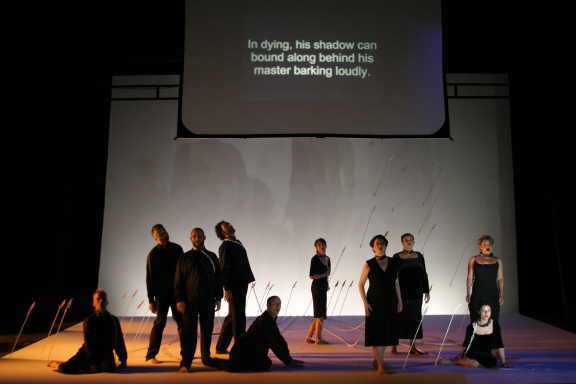
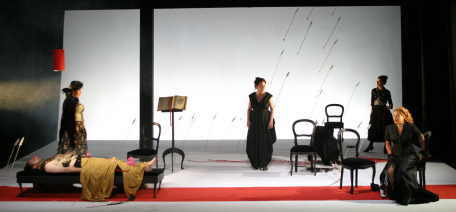
Libretto by Dagny Gioulami The Opera Group: This completion of a project stemming from the success of the one-acter Linen from Smyrna in Zurich (2001) has a worrying disunity despite its three components being loosely linked through Odysseus and the Trojan War. It came to my attention through an encouraging review of its Cheltenham premiere in The Guardian - "- - a marvellous piece, original in structure, packed with deft ensemble writing and expressive vocal lines, and both funny and moving - A triumph for all concerned", reminding me of my early championship of Edward Rushton (b. 1972) and disappointment with his opera The Young Man with the Carnation at Almeida Opera. Pertinent excerpts from reviews of it are copied below. Is Andrew Clements a classical scholar, familiar with all the myths drawn upon, or had The Guardian the advantage of prior sight of the libretti, which were not available to critics in advance nor to ticket holders at Covent Garden? Philoctetes has its eponymous wounded 'hero' moaning about his painful snake-bite and screaming, tediously and interminably. Relief for us is afforded by a pair of roadside grill proprietors, who abuse all the greats of Greek mythology and ply our hero with booze; they're a double act, a little like those who kept us waiting for Godot. Neoptolemus has a serious twinge of conscience and Odysseus jumps out of a box. Most of this can be followed, but doing so takes too much attention from the interesting, idiosyncratic scoring for the chamber orchestra; a strength of Rushton's. A gloomy 50 minutes, not followed by the interval for refreshment, but instead by a short scene in which Odysseus's dog, represented improbably by the entire companyrecognises his master's return but dies before he can bark a welcome. The screen (see middle picture) carried the whole short text; it might better have been used for sur-titling the others! After the interval that earlier opera Linen from Smyrna, the hardest of the three parts to follow. It is about a cocktail party at which Odysseus's women quarrel over his corpse (a sort of Gianni Schicchi situation) - truths emerging that each would have preferred to remain secret. The Opera Group has kindly supplied me now with the libretti and Robert Day's photos of the admirable staging (Adam Wiltshire and Oliver Fenwick). These are very pretty pictures, but eyes are not enough to sustain an opera if the ears let you down. Dagny Gioulami's Linen from Smyrna is just too clever by half and didn't work in the theatre (Linbury, upstairs - where there is some knee-room, very restricted most elsewhere!). Again, the instrumental music is intrinsically far more interesting than the vocalisation. So for me Edward Rushton remains a composer of great promise who needs to simplify, and confront practicalities, if he is to become a really successful opera composer. Complex, dense and poetic libretti need help for listeners - composers from Handel to Birtwistle (The Io Passion) do this by repetition. A DVD would be fine but is unrealistic to expect; meanwhile a CD of The Trojan Trilogy, with libretti, would be the best way to get to grips with Rushton and his music. reviews of The Young Man with the Carnation: Seen&Heard (Peter Grahame Woolf, June 2002): - - A new one act opera for Almeida Opera by the Swiss-based British composer Edward Rushton compressed, to the point of incomprehensibility, a story about a young man with writer's block. It stood alone, lasting only 45 minutes - really not likely to make a satisfying evening out for an audience which had to tackle the hazards of London's travel systems! - - With no orchestra pit, a wind dominated chamber orchestra compelled the 'hero', sung by Peter van Hulle, to force his voice - - The other parts were shadowy and unrewarding, and one failed to become engaged in this Charlie's self-absorption and nocturnal roamings. Classical Source (Richard Whitehouse): In an opera of only 45 minutes duration, narrative action has to be clear and to the point. Rushton's vocal writing has a certain functional consistency - avoiding musical delineation of the characters but carrying the text effortlessly and projecting well over the 11-strong ensemble - - The Guardian (Andrew Clements): His instrumental writing has a real zip and imagination. But he is not yet so accomplished at communicating an operatic plot to an audience, or at least at calculating what listeners can absorb comfortably at a single performance. - - The vocal writing tends to be functional declamation that rarely takes flight. Around it, Rushden invents some remarkable sounds, using just single wind, strings and percussion. Photos by Robert Day |
 Edward Rushton Trojan Trilogy